
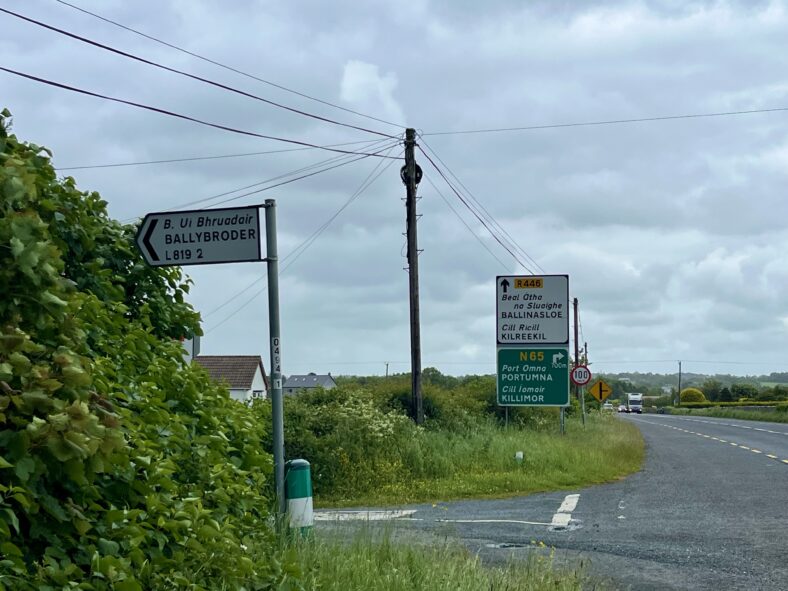
Ballybroder
County: Galway
Barony: Loughrea
Municipal District: Loughrea
Civil Parish: Loughrea
Roman Catholic Parish: Loughrea (St. Brendan’s)
District Electoral Division: Bullaun [1901], Bullaun [1911]
Area: 190.65 acres / 190 acres, 2 roods, 24 perches – according to Townlands.ie
OSI Map (Larkin, 1819): Available here
OSI Map (6″ OS, 1840): Available here
Irish Form Of Name: According to Logainm, the Irish name for Ballybroder is Baile Uí Bhruadair (Baile, meaning ‘townland, town, or homestead’). O’Donovan’s Field Name Books translated the townland as ‘O’Broder’s Town.’
O’Donovan’s Field Name Books
Description: ‘This is a large townland of an irregular form, principal part of it arable, the remainder bog. It contains one School House, 20 Scholars, one castle and one Danish Fort. It is the property of Mrs. Burke. Rent from ? £1.8. County Cess 1s. 3d. half yearly.’
Situation: ‘Forms the N. Eastern part of the parish, is bounded by the townlands of Lisduff and Meeleen [Moyleen] in this Parish, by Ballybroder in that of Kilmeen and Barony of Loughrea by Bealagarra in Parish of Bullaun and aforesaid Barony and by Cahernagarry and Kilboy […] in the parish of Kilreekil [Kilrickle] and Barony of Athenry.’
Ordnance Survey Letters Description: ‘Lady’s well lies in Ballybroder townland, Baile Uí Bhródair, where there is also an old Castle in ruins.’ – Volume 2, p. 232.
Griffith’s Valuation (1847-1864) For Ballybroder
According to Griffith’s Valuation, the townland of Ballybroder comprised 282 acres and 1 rood of land, at a total annual valuation of £129 15s. Peter Dolphin and Patrick Burke were the primary resident proprietors, who held the majority of land in fee and leased land to the other occupants. There were 4 occupants recorded in Ballybroder: Peter Dolphin, Patrick Burke, Thomas Lyons and John Donegan.
The largest individual holding was held by Peter Dolphin, who held 155 acres, 2 roods and 10 perches of land, while the smallest holding was held by Thomas Lyons, who held 8 acres, 3 roods and 9 perches of land. Names which appeared holding a house and offices included Peter Dolphin (herd’s house and cottier’s house) and Patrick Burke (house, offices, and cottier’s house), while Thomas Lyons and John Donegan each held a house and an office.
Peter Dolphin retained a portion of land for himself in fee, divided into 2 plots that measured 155 acres, 2 roods and 10 perches in total. The first plot of land had a herd’s house on it, for which he paid annual valuation rate of 10s. The second plot of land had a cottier’s house on it, for which he paid an annual valuation rate of 5s. He paid an annual valuation rate of £38 for the land on both plots combined. His total annual valuation of rateable property amounted to £38 15s.
Patrick Burke retained a portion of land for himself in fee, divided into 2 plots that measured 106 acres, 1 rood and 3 perches in total. The first plot of land had a house and offices on it, for which he paid an annual valuation rate of £10. The second plot of land had a cottier’s house on it, for which he paid an annual valuation rate of 5s. He paid an annual valuation rate of £72 for the land on both plots combined. His total annual valuation of rateable property amounted to £82 10s.
Patrick Burke leased tenements in Ballybroder to two other occupants, Thomas Lyons and John Donegan. Thomas Lyons leased 8 acres, 3 roods and 9 perches of land, on which he had a house and an office. He paid an annual valuation rate of £3 for the land and 10s for the buildings, with his total annual valuation of rateable property amounting to £3 10s.
John Donegan leased 11 acres, 2 roods and 18 perches of land, on which he had a house and an office. He paid an annual valuation rate of £4 10s for the land and 10s for the buildings, with his total annual valuation of rateable property amounting to £5.
The total annual valuation of ratable property paid overall in Ballybroder was £117 10s for the land and £12 5s for the buildings, with the townland’s total valuation amounting to £129 15s. The land in Ballybroder was valued at approximately 8s 4d per acre.
1901 Census For Ballybroder
Overview Of Ballybroder In 1901
According to the 1901 Census, there were a total of 3 households in Ballybroder, all classed as private dwellings. According to Form B1 of the House and Building Return, all were constructed with walls made of stone, brick or concrete. The first household (Burke) had a roof made of non-perishable material such as slate, iron or tile, while the second and third households (Barrett and Fahy) had roofs made of thatch, wood or other perishable material. Each household had a different number of front windows, with the first having 5, the second having 2, and the third having none. Each household was a different class/grade, with the first household being 1st-class, the second being 3rd-class and the third being 4th-class.
According to the Enumerator’s Abstract Return, there were 10 individuals in Ballybroder at that time, consisting of 6 males and 4 females, with an average age of 33 (32.8). Every individual was Roman Catholic. Literacy was 20% (2 individuals) able to read and write, 30% (3 individuals) able to read only, while the remaining 50% (5 individuals) were illiterate. Bilingualism was present in the Barrett and Fahy households, as 50% (5 individuals) were recorded as being able to speak both Irish and English (Thomas Barrett, Norah Barrett, and the entire Fahy household). Additionally, while most inhabitants were local, the Burke siblings were born in Longford [or possibly Loughrea], Co. Galway.
The heads of each household in Ballybroder were John Burke, Thomas Barrett and Bridget Fahy. According to Form B2 of the Out-Offices and Farm-Steadings Return, there were a total of 11 out-offices in Ballybroder: 2 stables, a coach house, a cow house, 3 calf houses, 2 piggeries, a fowl house and a barn. The landholders were John Burke, Michael Smith and Bridget Fahy. The enumerator was Const. John Clarke.
The head of the first household in Ballybroder was John Burke (44), whose occupation was listed as a ‘gentleman farmer.’ He shared the home with his sister, Eleanor Burke (33), who was also unmarried. Both members of the household were Roman Catholic, could read and write, and were born in Longford [or Loughrea], Co. Galway.
They lived in a 1st-class, 10-roomed private dwelling, with 5 windows in the front. The walls of the home were made of stone, brick or concrete, with slate, iron, tile, or other non-perishable material used for roofing. There were 9 out-offices attached to the household: 2 stables, 2 calf houses, a coach house, a cow house, a piggery, a fowl house and a barn. John Burke was the landholder.
The head of the second household in Ballybroder was Thomas Barrett (45), a shepherd, who lived with his wife, Norah Barrett (42). They shared the home with their two sons, William (16), John (9), and their daughter, Mary Ellen (3), all of whom were unmarried. William (16) and John (9) were scholars. All members of the household were born in Co. Galway and were Roman Catholic. Thomas (45) and Mary Ellen (3) could not read, while the other members of the household could read only. Thomas and Norah were the only members of the household who could speak both Irish and English.
They lived in a 3rd-class, 3-roomed private dwelling with 2 windows in the front. The walls of the home were made of non-perishable material, such as brick, stone or concrete, while thatch, wood or other perishable material was used for roofing. There were 2 out-offices attached to the household: a calf house and a piggery. The landholder was Michael Smith.
The head of the third household in Ballybroder was Bridget Fahy (70), a widow, who shared the home with her two sons, James (35) and Patrick (31), both of whom were unmarried. Bridget’s occupation was a farmer, while her two sons were listed as ‘farmer’s sons.’ Every member of the household was born in Co. Galway, was Roman Catholic, could speak both Irish and English, and could not read.
They lived in a 4th-class, single-roomed private dwelling with no front windows. The walls of the home were made of non-perishable material, such as brick, stone or concrete, while thatch, wood or other perishable material was used for roofing. There were no out-offices attached to the household. Bridget Fahy was the landholder.
1911 Census For Ballybroder
Overview Of Ballybroder In 1911
According to the 1911 Census, there were a total of 2 households in Ballybroder at that time, both classed as 2nd-class private dwellings. According to Form B1 of the House and Building Return, the walls of both households were constructed of stone, brick or concrete. The first household (Burke) had a roof made of non-perishable material, such as slate, iron or tile, while the second household (Barrett) had a roof made of thatch, wood or other perishable material. The first household contained 7 rooms and had 5 front windows, while the second household contained 3 rooms and had 3 front windows.
The Enumerator’s Abstract Return recorded a total of 5 individuals in Ballybroder at that time, consisting of 3 males and 2 females, with an average age of 40 (39.6). Every individual was Roman Catholic and born in Co. Galway. Literacy was 60% (3 individuals) able to read and write, while 40% (2 individuals) could read only. Bilingualism was present in the Barrett household, where 2 individuals (40%) were recorded as being able to speak both Irish and English (Thomas and Nora Barrett). The enumerator was Const. Andrew Murphy.
The heads of each household were Eleanor M. Burke and Thomas Barrett. Eleanor M. Burke was the landholder for both households. According to the Out-Offices and Farm-Steadings Return form, there were a total of 11 out-offices in Ballybroder: 1 stable, 1 coach house, 2 cow houses, 1 calf house, 2 piggeries, 1 fowl house, 1 barn, and 2 sheds.
The head of the first household in Ballybroder was Eleanor M. Burke (47), who was single and lived alone. She was born in Co. Galway, was Roman Catholic, and could read and write. She lived in a 2nd-class, 7-roomed private dwelling with 5 windows in the front. The walls of the home were made of non-perishable material, such as stone, brick or concrete, while slate, iron, tile or other non-perishable material was used for roofing. There were 8 out-offices attached to the household: 1 stable, 1 coach house, 1 cow house, 1 calf house, 1 piggery, 1 fowl house, 1 barn and 1 shed. Eleanor M. Burke was the landholder.
The head of the second household in Ballybroder was Thomas Barrett (57), a shepherd, who lived with his wife, Nora (50). They had been married for 30 years, and had 4 children, of whom 2 survived. They shared the home with their two sons, William (26) and John (18), both of whom were unmarried. William and John were also shepherds. All members of the household were born in Co. Galway and were Roman Catholic. Thomas (57) and Nora (50) could speak Irish and English and could read only. William (26) and John (18) could read and write.
They lived in a 2nd-class, 3-roomed private dwelling with 3 windows in the front. The walls of the home were of non-perishable material such as stone, brick or concrete, while wood, thatch or other perishable material was used for roofing. There were 3 out-offices attached to the household: 1 cow house, 1 piggery and 1 shed. Eleanor M. Burke was the landholder.
No Comments
Add a comment about this page