
Ballygasty
County: Galway
Barony: Loughrea
Municipal District: Loughrea
Civil Parish: Loughrea
Roman Catholic Parish: Loughrea (St. Brendan’s)
District Electoral Division: Loughrea Rural
Area: 286.07 acres – 286 acres, 0 roods, 11 perches, according to Townlands.ie.
OSI Map: Available here.
Irish Form Of Name: According to Logainm, the Irish name for Ballygasty is ‘Bile Gasta’ (Bile, meaning ‘(large, sacred) tree’). According to O’Donovan’s Field Name Books, the Irish form of the name was ‘Baile Ghasta’, which it translated as ‘Gasty’s Town’.
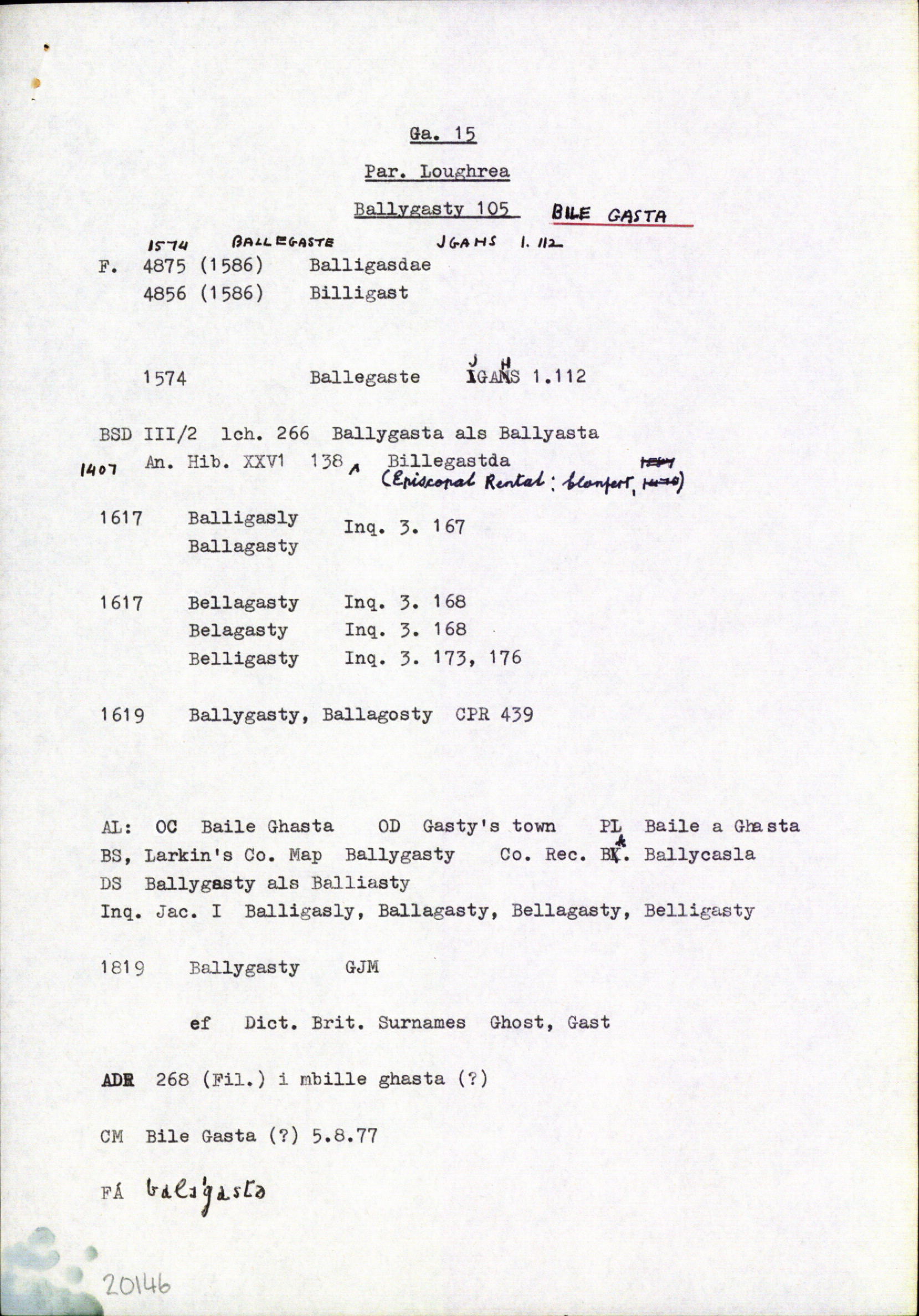
O’Donovan’s Field Name Books
Description: ‘This is a large and irregularly formed townland, nearly all arable, there is a small portion of bog in its S. Western quarter. It contains the ruins of an old Castle, a Corn Mill and pond. Proprietor Mr. Seymor. Rent per acre £1.3.
Situation: ‘Northern part of the parish is bounded by the townlands of Cussmoana [Cosmona], Caheronaun, Graig [Graigue] and Curragh? [Curraghs] in this parish, by Lackalea, Cahernamuck [Cahernagormuck] East and Rouddy [Raruddy East] ? East in that of Kilconickny.’
Information From Ordnance Survey Letters: ‘An old Castle stands in ruins in the townland of Ballygasty, Baile Ui Ghasta’ (Volume 2, Page 233).
Griffith’s Valuation (1847-1864) For Ballygasty
According to Griffith’s Valuation, the townland of Ballygasty comprised 280 acres, 1 rood and 15 perches of land, at a total annual valuation of £145 11s. Thomas Seymour was the landowner and immediate lessor for every household recorded within the townland, which was divided among 8 occupiers. These occupiers were John Gallagher, Patrick Fahy, Patrick Nevin, Margaret Nevin, Patrick O’Neill, Benjamin Smith, Bernard McDowall, and William Mulkerin.
The largest individual holding within the townland was held by John Gallagher, who leased 114 acres, 3 roods and 26 perches, while the smallest individual holding was held by Patrick O’Neill, who held 4 acres, 2 roods and 25 perches of land.
Names which appeared holding a house and offices were John Gallagher and Patrick Nevin, while William Mulkerin held a house and an office. Benjamin Smith held an office only, while Patrick Fahy and Margaret Nevin were recorded as holding house only. The townland also featured a herd’s house, a labourer’s house and a ‘corn and tuck-mills.’
John Gallagher leased 2 separate plots of land, which measured 114 acres, 3 roods, and 26 perches in total. The first plot of land was 111 acres and 35 perches in size, on which he had a herd’s house and offices. He paid an annual valuation rate of £44 15s for the land and £1 5s for the buildings. The second plot of land was 3 acres, 2 roods and 31 perches in size, for which he paid an annual valuation rate of £1 5s. His total annual valuation of rateable property amounted to £47 5s.
Patrick Fahy leased 12 acres, 2 roods and 13 perches of land, on which he had a house. He paid an annual valuation rate of £6 for the land and 5s for the buildings, with a total annual valuation of rateable property of £6 5s.
Patrick Nevin leased 2 separate plots of land, which measured 69 acres and 33 perches in total. The first plot of land had on it a house, offices, and a ‘corn & tuck-mills’, for which he paid an annual valuation rate of £36 for the land, and £6 15s for the buildings. The second plot of land contained a labourer’s house, for which he paid an annual valuation rate of 5s. His total annual valuation of rateable property amounted to £43.
John Gallagher, Patrick Fahy and Patrick Nevin each leased a portion of ‘bog’ land held in common, measuring 12 acres and 35 perches in total. Each man paid an equal annual valuation rate of £7 for their respective portion of this shared land.
Margaret Nevin leased 5 acres and 37 perches of land on which she had a house. She paid an annual valuation rate of £2 10s for the land and 10s for the buildings, with a total annual valuation of rateable property of £3.
Patrick O’Neill leased 4 acres, 2 roods and 25 perches of land, for which he paid an annual valuation rate of £1 15s.
Benjamin Smith leased 25 acres, 1 rood and 2 perches of land on which he had an office. He paid an annual valuation rate of £16 10s for the land and 5s for the buildings, with a total annual valuation of rateable property of £16 15s.
Bernard McDowall leased 10 acres, 1 rood and 20 perches of land, for which he paid an annual valuation rate of £10 10s.
William Mulkerin leased 25 acres, 3 roods and 24 perches of land, on which he had a house and an office. He paid an annual valuation rate of £15 on the land and £1 on the buildings, with a total annual valuation of rateable property amounting to £16.
The total annual valuation of rateable property paid overall in Ballygasty was £135 6s for the land and £10 5s for the buildings, with the townland’s total valuation amounting to £145 11s. The land in Ballygasty was valued at approximately 9s 8d per acre.
1901 Census For Ballygasty
Overview Of Ballygasty (Loughrea Rural) In 1901
According to the 1901 Census, there was 1 household in Ballygasty, which was a private dwelling. According to Form B1 of the House and Building Return, it was constructed of stone, brick or concrete walls, and had thatch, wood or other perishable material for roofing. It was a 2nd-class, 3-roomed dwelling, with 3 windows in the front.
The Enumerator’s Abstract Return recorded a total of 3 individuals in Ballygasty at that time, consisting of 1 male and 2 females, with an average age of 29 (28.7). Every individual was born in Co. Galway and was Roman Catholic. Literacy levels were high, with every individual in the townland being able to read and write. Timothy and Annie Fahy reported speaking both Irish and English, while Mary Anne Fahy spoke English only. All 3 residents were unmarried, and the household included a visitor (Mary Anne Fahy) who was also a family member.
According to Form B2 of the Out-Offices and Farm-Steadings Return, there were a total of 5 out-offices in the townland: a stable, a cow house, a calf house, a piggery and a barn. The head of the household and landholder was Timothy Fahy. The enumerator was Const. John Clarke.
The head of the only household in Ballygasty was Timothy Fahy (32), a farmer, who shared the home with his sister, Annie Fahy (33), whose occupation was a ‘farmer’s sister’, and his niece, Mary Anne Fahy (21), whose occupation was listed as a ‘visitor’. Every member was unmarried, was born in Co. Galway, was Roman Catholic, and could read and write. All could speak both Irish and English, except for Mary Anne (21), who spoke English only.
They lived in a 2nd-class, 3-roomed private dwelling with 3 windows in the front. The walls of the home were made of non-perishable material, such as stone, brick or concrete, while wood, thatch or other perishable material was used for roofing.
There were 5 out-offices attached to the household: a stable, a cow house, a calf house, a piggery and a barn. Timothy Fahy was the landholder.
1911 Census For Ballygasty
Overview Of Ballygasty (Loughrea Rural) In 1911
According to the 1911 Census, there was 1 household in Ballygasty, a 2nd-class, 4-roomed private dwelling with 3 front windows. According to Form B1 of the House and Building Return, it was constructed of stone, brick or concrete walls, and had thatch, wood or other perishable material for roofing. The Enumerator’s Abstract Return recorded a total of 3 individuals in Ballygasty at that time, 1 male and 2 females, with an average age of 29 (28.7). Every individual was born in Co. Galway, was Roman Catholic and was single. Literacy was 100%, with all members able to read and write.
According to Form B2 of the Out-Offices and Farm-Steadings Return, there were a total of 6 out-offices in the townland: 1 stable, 1 coach house, 1 cow house, 1 piggery, 1 fowl house and 1 barn. The enumerator was Const. Andrew Murphy.
The head of the only household in Ballygasty was Timothy Fahy (40), a farmer who was unmarried. He shared the home with his sister, Anne (41), and his niece, Mary Anne (30). Every individual was born in Co. Galway, was Roman Catholic and was single. All three could read and write. They lived in a 2nd-class, 4-roomed private dwelling with 3 front windows. The walls of the home were made of stone, brick or concrete, while thatch, wood or other perishable material was used for roofing. There were 6 out-offices attached to the household: 1 stable, 1 coach house, 1 cow house, 1 piggery, 1 fowl house and 1 barn. Timothy Fahy was the landholder.
No Comments
Add a comment about this page