
Castlefield, Templetogher
Logainm
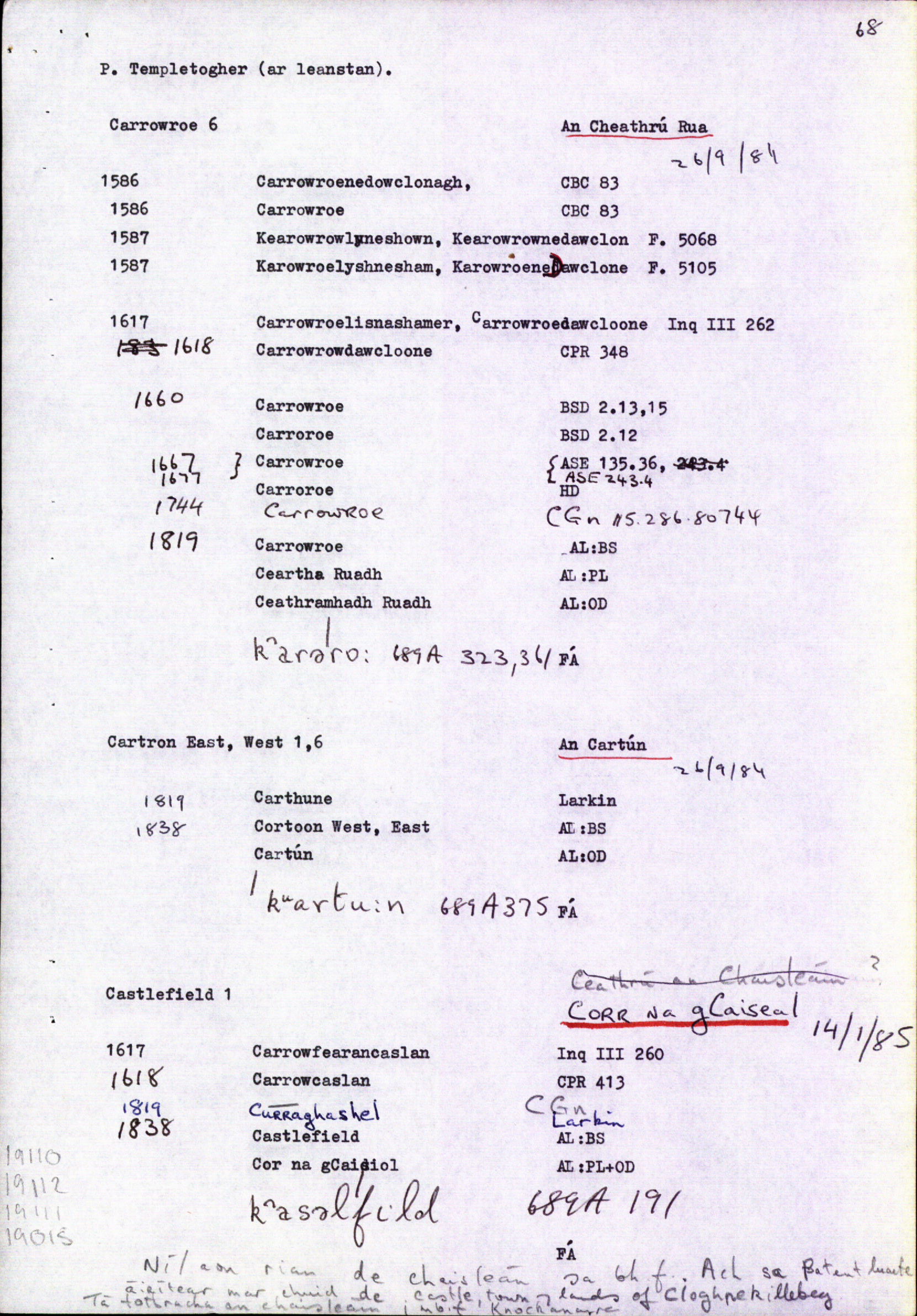
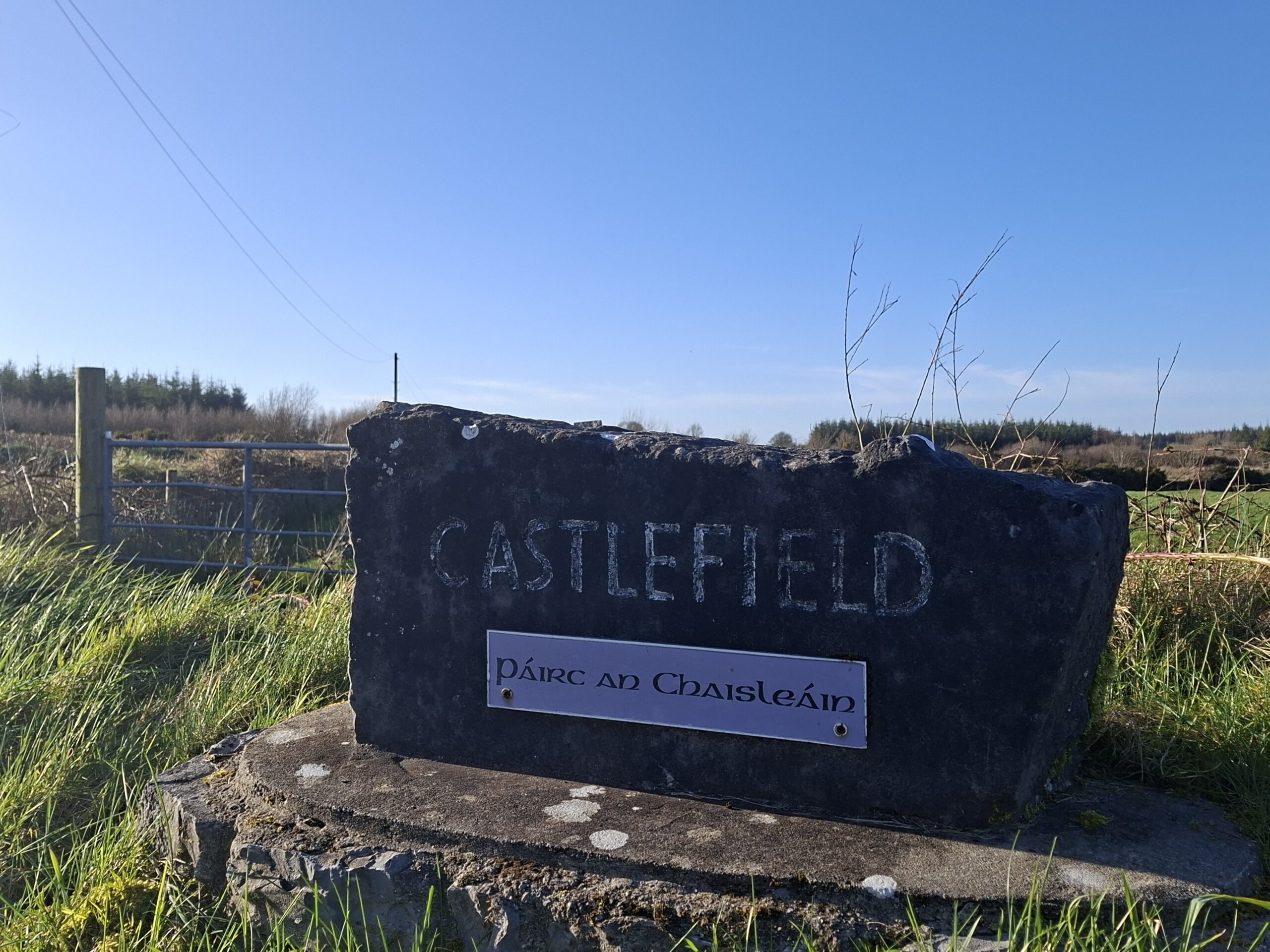
The townland of Castlefield is located within the parish of Templetogher, barony of Ballymoe, county Galway. In Irish, its name is Cor na gcaisiol, meaning round hill of the stone forts. It was fist documented in 1617 under the name “Carrowfearancaslan” . There were 5 different recorded place names for this townland across time. O’Donovans Field Name Documents give details on its description and situation, stating “About 3/5 of this townland is bog. Centre of road forms the East boundary. The remainder of the land is tillage and pasture. Castlefield is situated at the North boundary of this parish [Unable to read.] the parish of Kiltullagh, Barony of Ballintubber, County Roscommon.” Its geographic centre point is 53.7128, -8.57292.
1856 Griffiths Valuation
There are 9 households in the townland. The immediate lessor for every entry is Sir Thomas J. Burke Bartholmew, as indicated by his name, “Same” or “In fee”. There is housing, offices, a corn mill, land and bog in this townland. The properties are 284 acres, 3 roods and 18 perches in size and the land is valued at 33 pounds and 6 shillings. The buildings were valued to be 8 pounds and 14 shillings, totalling a value of 42 pounds across the townland. View the original documentation here.
Entry one is occupied by Bernard Breheny. There are a house, office, corn mill and land listed. There is 17 acres, 2 roods and 13 perches recorded and valued at 4 pounds and 15 shillings. The buildings are listed at an additional 4 pounds in value, amounting to 8 pounds and 15 shillings.
The occupier of entry two is John Govern. He rented a house and land. The land was 10 acres, 3 roods and 10 perches in size and valued at 3 pounds and 15 shillings. The house was valued at 10 shillings. The total value of this property was deemed to be 4 pounds and 5 shillings.
Michael Collins is the occupier for entry three. There is a house, office and land recorded. The size of the property was 11 acres, 3 roods and 35 perches. The land was valued at 4 pounds and the building was valued at 15 shillings, bring the total value of the property to 4 pounds and 15 shillings.
Entry four is occupied by Patrick Carly. There is a house, office and land recorded. The land is 3 acres, 1 rood and 18 perches in size. The land is valued at 3 pounds and 10 shillings. The buildings are valued at one pound, thus bringing the total value to 4 pounds and 10 shillings.
Entry five is occupied by Michael Carly. There is a house, office and land recorded. The land is 25 acres, 1 rood and 10 perches in size. The land is valued at 7 pounds and 5 shillings. The buildings are valued at 1 pound, thus bringing the total value to 8 pounds and 5 shillings
Entry six is occupied by Michael Flynn. There is a house, office and land recorded. The land is in 8 acres, 2 roods and 11 perches in size. The land is valued at 2 pounds and 8 shillings. The buildings are valued at 12 shillings, thus bringing the total value to 3 pounds.
Entry seven is occupied by Thomas Scully. There is a house, office and land recorded. The land is 14 acres, 3 roods and 5 perches in size and is valued at 3 pounds and 13 shillings. The buildings are valued at 17 shillings, thus bringing the total value to 4 pounds.
Entry eight is occupied by Bernard Sweeney. He rented land 16 acres, 3 roods and 24 perches in size. It was valued at 2 pounds and 10 shillings.
Entry nine is the final entry and is occupied by Sir Thomas J. Burke Bartholmew. He is also the immediate lessor, indicated by “In fee”. The property description indicates that this is a bog. It is 168 acres, 2 roods and 2 perches in size and is valued at 1 pound and 10 shillings.
1901 Census
According to the Enumerator’s Abstract (Form N), there were 7 households in this townland. There were 23 males and 18 females. All were Roman Catholic. There were 18 outhouses, one 3rd class private dwelling and six 2nd class private dwellings in this townland.
Household 1
The head of household was Michael Carley (70), a married farmer that could read and write. His wife, Mary (60) could not read but could. All occupants were listed as Catholic and could speak Irish and English. Their son, Pat (45) was a married farmer who could read and write. Their daughter in law Anne (40) could read and write and was originally from Roscommon. Their grandson, William (2) was listed as a farmer’s son and could not read. Their second grandson, Michael (1) was also listed as a farmer’s son and could not read.
According to Form B1, they lived in a 3rd class private dwelling. The walls were made out of stone, brick or concrete. The roof was wood, thatched or made of another perishable material. There were between 2 and 4 rooms in the house. There were 2 windows at the front of the building. According to Form B2, there were 2 outhouses, a cowhouse and piggery.
Household 2
The head of household was listed as Patt Breheny [sic] (58). His wife, Mary (40) could read and write in Irish and English and was originally from Mayo. They lived with their 10 children. Mary-Anne (16) was an unmarried Farmer’s daughter that could read and write. Bernard (13), Sabina (11), Margaret (10) and Patrick (8) were listed as scholars that could read and write. In addition, Michael (6), Bridget (4), John (3) and Ellen (1) were listed as scholars that could not read.
According to Form B1, they lived in a 2nd class private dwelling. The walls were made out of stone, brick or concrete. The roof was wood, thatched or made of another perishable material. There were between 2 and 4 rooms in the house. There were 3 windows at the front of the building According to Form B2, there were 2 outhouses, a cowhouse and piggery.
Household 3
Thomas Scally (50) is listed as the head of household, a married labourer. His wife, Catherine (45) was listed as a housekeeper. Their son, John (20) was an unmarried labourer. All were from Galway and could all read and write in English language [sic] [illegible]. Maggie (19), their eldest daughter was listed as an unmarried farmer’s daughter, while Kate (15) and Mary (12) were listed as scholars.
According to Form B1, they lived in a 2nd class private dwelling. The walls were made out of stone, brick or concrete. The roof was wood, thatched or made of another perishable material. There were between 2 and 4 rooms in the house. There were 3 windows at the front of the building. According to Form B2, there were 4 outhouses, which included a cowhouse, piggery, barn and store.
Household 4
The head of household was John Collins (39), an unmarried farmer who could read and write in Irish and English. He lived with sister Margaret (25) an unmarried housekeeper. who could read and write in Irish and English.
According to Form B1, they lived in a 2nd class private dwelling. The walls were made out of stone, brick or concrete. The roof was made of slate, tile or iron. There were between 2 and 4 rooms in the house. There were 3 windows at the front of the building. According to Form B2, outhouses included a cowhouse, piggery and barn.
Household 5
John O’Grady (67) was the head of household, a widower from Roscommon, he was listed as a farmer. He lived with his son, Patrick (27), an unmarried farmer, born in Galway. Both could read and write in Irish and English
The head of household was According to Form B1, they lived in a 2nd class private dwelling. The walls were made out of stone, brick or concrete. The roof was wood, thatched or made of another perishable material. There were between 2 and 4 rooms in the house. There were 3 windows at the front of the building. According to Form B2, According to Form B2, there were 2 outhouses, a cowhouse and piggery.
Household 6
Thomas Gaffey (60) was the head of household. He was a widower from Roscommon who was listed as a farmer. He lived with his 4 children. Mary (25) was an unmarried housekeeper. Peter (23) and Patrick (20) were listed as unmarried farmer’s sons. Seamus (12) was listed as a scholar. All could read and write.
The head of household was According to Form B1, they lived in a 2nd class private dwelling. The walls were made out of stone, brick or concrete. The roof was wood, thatched or made of another perishable material. There were between 2 and 4 rooms in the house. There were 3 windows at the front of the building. According to Form B2, there were 2 outhouses, a cowhouse and piggery.
Household 7
Edward Tarmey (55) was the head of household. His wife was Mary (48). Their two eldest children James (20) and Mary (16) were both unmarried. All 4 listed their occupation as ‘Herd’. Additionally, they had 4 children listed as scholars John [illegible] (14), Kate (11) Thomas (8) Eddie (6) and Ellen (3). All were listed as being born in Ireland. Only Edward and his wife Mary could speak Irish. All but Edward could read or write.
According to Form B1, they lived in a 2nd class private dwelling. The walls were made out of stone, brick or concrete. The roof was made of slate, tile or iron. There were between 2 and 4 rooms in the house. There were 3 windows at the front of the building. According to Form B2, outhouses included a cowhouse, piggery and barn.
1911 Census
According to the Enumerator’s Abstract, there were 7 households in this townland. There were 21 males and 11 females. All were Roman Catholic and originally from Galway. There were 25 outhouses, four 2nd class private dwellings and three 3rd class private dwellings.
Household 1
The head of household was listed as Thomas Scally (68) [illegible] was a married farmer that could read and write in Irish and English. His wife Kate (60) could read and write. Their son John(27) was a farm labourer and both him and their daughter Mary (19) could read and write in Irish and English. According to Form B1, they lived in a 2nd class private dwelling. The walls were made of brick, stone or concrete. The roof was wood, thatch or made of another perishable material. There were between 2 and 4 rooms in the house and 3 windows at its front. Form B2 states that there were 6 outhouses, a stable, a coach house, a cow house, piggery, fowl house and barn.
Household 2
The head of household was listed as Edward Tarmey (68), his wife was Mary (59). They had three children, Thomas (19) was listed as an unmarried Farmer’s Son. Edmund [illeligible](16) and Ellen (13) were listed as scholars. All could read and write, but only Edward (head of household) and Mary could speak Irish and English. All were from Galway. Form B1 states that they lived in a 2nd class private dwelling. The walls were made of brick, stone or concrete. The roof was made of slate, iron or tile. There were between 2 and 4 rooms in the house and 2 windows at the front. According to Form B2, there was a also a fowl house and cow house on the property.
Household 3
The head of household was listed as Patrick Carley (56) was a farmer that could read and write. His wife Annie (50) was also listed as a farmer. They had 5 children, only 4 of which were recorded as living. Michael (10), Luke (9) Patrick (8) and Mary Kate (7) were all listed as schoalrs. According to Form B1, they lived in a 3rd class private dwelling. The walls were made of brick, stone or concrete. The roof was wood, thatch or made of another perishable material. There was 1 room in the house and 2 windows at the front. According to Form B2, there was also a cowhouse and piggery.
Household 4
The head of household was listed as Peter Gaffey (41) was an unmarried carpenter. He lived with his brother William (30), who was also a carpenter, and his second brother James (24), who was a farmer. All could read and write, and all were listed as single. According to Form B1, they lived in a 3rd class private dwelling. The walls were made of brick, stone or concrete. There was 1 room in the house and 3 windows at its front. According to Form B2, there were two stables, a cow house, piggery, fowl house and barn for a total of six outhouses.
Household 5
The head of household was listed as John Collins (40), an unmarried farmer that could read and write. He lived with his sister Margaret (35), who could read and write and was also listed as a farmer. According to Form B1, they lived in a 2nd class private dwelling. The walls were made of brick, stone or concrete. The roof was wood, thatch or made of another perishable material. There were between 2 and 4 rooms in the house and 3 windows at its front. According to Form B2, there was one stable, cowhouse and piggery on the property.
Household 6
The head of household was listed as Patrick Gready (40), an unmarried farmer. He lived with his sister Ellen Grady [sic] (34), who was also unmarried. Both could read and write. According to Form B1, they lived in a 3rd class private dwelling. The walls were made of brick, stone or concrete. The roof was wood, thatch or made of another perishable material. There was 1 room in the house and 2 windows at the front. According to Form B2, there was one stable and a cowhouse on the property.
Household 7
The head of household was listed as Patrick Judge (62), a miller who could read and write. His wife was Mary (54). They had 11 children, only 10 of which were alive during the census. Patrick (18) and Bernad (24) were listed as farm labourers. Michael (15), John (13), Andrew (9) were listed as scholars. Their two daughters, Maggie (19) had no occupation, while Bridget (16) was listed as a scholar. All children were single and all could read and write. According to Form B1, they lived in a 2nd class private dwelling. The walls were made of brick, stone or concrete. The roof was wood, thatch or made of another perishable material. There were between 2 and 4 rooms in the house and 4 windows at the front. According to Form B2, there was a cow house, piggery, fowl house and barn on the property, equating to 4 outhouses.
No Comments
Add a comment about this page