
Carn
County: Galway
Barony: Loughrea
Municipal District: Loughrea
Civil Parish: Loughrea
Roman Catholic Parish: Loughrea (St. Brendan’s)
District Electoral Division: Loughrea Rural
Area: 225.40 acres (225 acres, 1 rood, 24 perches), according to Townlands.ie.
OSI Map (Larkin, 1819): Available here
OSI Map (6” OS, 1840): Available here
Irish Form Of Name: The Irish form of the name according to Logainm is ‘An Carn’ (carn meaning ‘cairn, pile of rocks.’). According to O’Donovan’s Field Name Books, the irish form of the name is ‘Carn’, which it translated as ‘a heap.’
O’Donovan’s Field Name Books
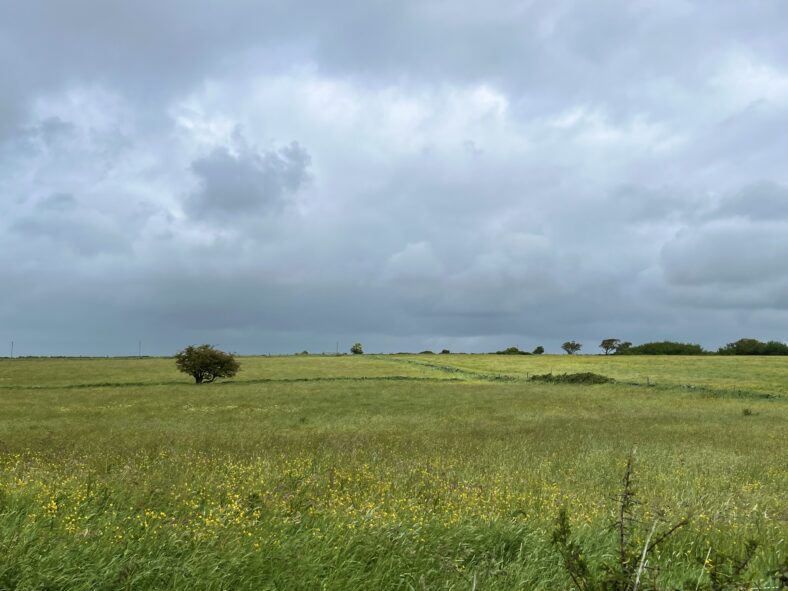
Description: ‘This townland is nearly all pasture and the property of the Earl of Clanricarde. It contains a Danish Fort and 1 Trigonometrical Station. Rent per acre £1.15 to £2. County Cess 1s. 1d. half yearly.’
Situation: ‘In the Eastern part of the parish, is bounded by the townland of Meeleen [Moyleen], Fairfield, Gorteenapheebera and Knockaddikan [Knockadikeen] in this parish and by Carhoomore [Carrowmore] in that of Kilmeen.’
Griffith’s Valuation (1847-1864) For Carn
According to Griffith’s Valuation, the townland of Carn comprised 225 acres, 1 rood and 3 perches of land, at a total annual valuation of £153 10s. There were 2 occupiers recorded: Matthew Rush and James Smith. The Marquis of Clanricarde was the landowner and immediate lessor for the entire townland. Names which appeared holding a house included both occupiers, each with a herd’s house. No residential dwellings or offices were recorded, indicating that Carn functioned primarily as grazing land.
Matthew Rush leased 52 acres and 5 perches of land, on which he had a herd’s house. He paid an annual valuation rate of £38 for the land and 5s for the buildings, with a total annual valuation of rateable property amounting to £38 5s.
James Smith leased 173 acres and 38 perches of land, on which he had a herd’s house. He paid an annual valuation rate of £115 for the land and 5s for the buildings, with a total annual valuation of rateable property amounting to £115 5s.
The total annual valuation of rateable property paid overall in Carn was £153 for the land and 10s for buildings, with the townland’s total valuation amounting to £153 10s. The land in Carn was valued at approximately 13s 7d per acre.
1901 Census For Carn
Overview of Carn (Loughrea Rural) In 1901
According to the 1901 Census, there was 1 household in Carn, classed as a private dwelling. According to Form B1 of the House and Building Return, it was a 2nd-class, 5-roomed dwelling with 2 windows in the front. The walls of the home were made of non-perishable material such as stone, brick or concrete, while slate, iron, tile or other non-perishable material was used for roofing.
The Enumerator’s Abstract Return recorded a total of 6 individuals in Carn at that time, consisting of 4 males and 2 females, with an average age of 36 (36.3). Every individual was Roman Catholic and born in Co. Galway. Literacy was 100%, with all 6 individuals able to read and write. Bilingualism was 100%, with all 6 individuals able to speak both Irish and English.
The head of the household was Michael Finnerty. The landholder was Lord Clanricarde. According to Form B2 of the Out-Offices and Farm-Steadings Return, there were 2 out-offices in the townland: a stable and a cow house.
The head of the only household in Carn was Michael Finnerty (64), a shepherd, who shared the home with his wife Bridget Finnerty (57), their daughter Margaret Finnerty (16), and their three sons, Jerimiagh Finnerty (32), John Finnerty (27), and Michael Finnerty (22), all of whom were shepherds. All of their children were unmarried. Every member of the household was Roman Catholic and born in Co. Galway. All were recorded as able to read and write, as well as able to speak both Irish and English.
They lived in a 2nd-class, 5-roomed private dwelling with 2 front windows. The walls of the home were made of stone, brick or concrete, while slate, iron or tile was used for roofing. There were 2 out-offices attached to the household, a stable and a cow house. Lord Clanricarde was the landholder.
1911 Census For Carn
Overview Of Carn (Loughrea Rural) In 1911
According to the 1911 Census, there was 1 household in Carn, classed as a private dwelling. According to Form B1 of the House and Building Return, it was a 2nd-class, 5-roomed dwelling with 2 windows in the front. The walls of the home were made of non-perishable material such as stone, brick or concrete, while slate, iron, tile or other non-perishable material was used for roofing.
The Enumerator’s Abstract Return recorded a total of 6 individuals in Carn at that time, consisting of 4 males and 2 females, with an average age of 27 (26.7). Every individual was Roman Catholic and born in Co. Galway.
Literacy was 50% (3 individuals) able to read and write, 16.7% (1 individual) able to read only and 33.3% (2 individuals) who were recorded as being unable to read. Bilingualism was present, with 16.7% (1 individual) recorded as able to speak both Irish and English (Bridget Finnerty).
The head of the household was Michael Finnerty. The landholder was Margaret Kennedy. According to Form B2 of the Out-Offices and Farm-Steadings Return, there were 3 out-offices in the townland: a stable, a piggery, and a barn.
The head of the only household in Carn was Michael Finnerty (33), a shepherd, who shared the home with his wife, Mary Finnerty (26), whom he had been married to for 2 years, their two sons, Michael (1) and Thomas Joseph (3 months old), his mother, Bridget Finnerty (69), a widow, and his brother, John Finnerty (31), an unmarried shepherd.
Every member of the household was born in Co. Galway and was Roman Catholic. Michael (33), Mary (26) and John (31) could read and write, Bridget (69) could read only, while Michael (1) and Thomas Joseph (3 months old) could not read. Bridget Finnerty (69) was the only member recorded as able to speak both Irish and English.
They lived in a 2nd-class, 5-roomed private dwelling with 2 front windows. The walls of the home were made of stone, brick or concrete, while slate, iron or tile was used for roofing. There were 3 out-offices attached to the household: a stable, a piggery and a barn. Margaret Kennedy was the landholder.
No Comments
Add a comment about this page