
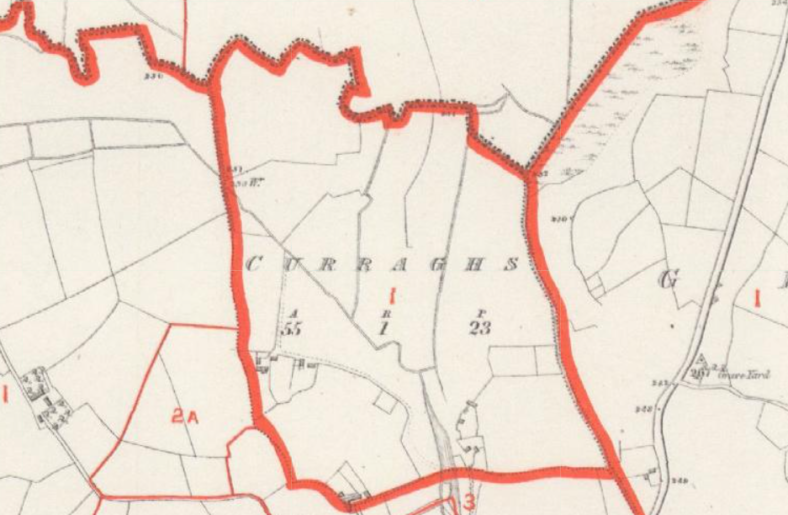
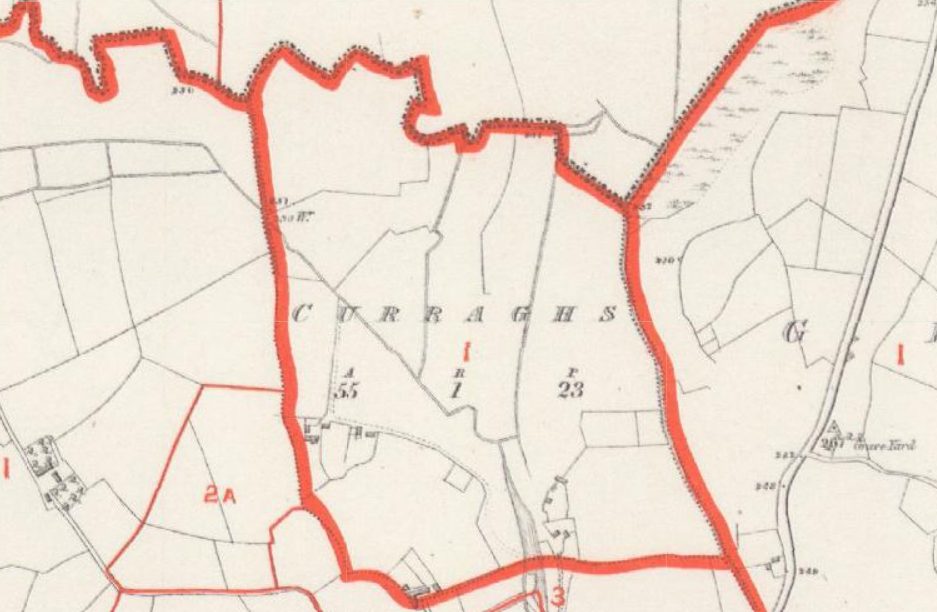
Curraghs
County: Galway
Barony: Loughrea
Municipal District: Loughrea
Civil Parish: Loughrea
Roman Catholic Parish: Loughrea (St. Brendan’s)
District Electoral Division: Loughrea Rural
Area: 55.04 acres (55 acres, 0 roods, 5 perches), according to Townlands.ie
OS Map (Larkin, 1819): Available here
OS Map (6” OS, 1840): Available here
Irish Form Of Name: According to Logainm, the Irish form of the name is ‘An Currach’, meaning ‘marsh’. According to O’Donovan’s Field Name Books, the Irish form of the name is ‘Currach’, meaning ‘a moor.’
O’Donovan’s Field Name Books
Description: ‘A small townland, nearly quadrangular in its form, all arable and contains nothing remarkable. It is the property of the Earl of Clanricarde. Rent per acre 16d to £1. Co. Cess 1s. 5d. half yearly.’
Situation: ‘In the Northern part of the parish is bounded by the townlands of Ballygasty and Graig [Graigue] in this parish and by Lackalea in that of Kilconickny.’
Griffith’s Valuation (1847-1864) For Curraghs
According to Griffith’s Valuation, the townland of Curragh comprised 55 acres, 1 rood and 23 perches of land, at a total annual valuation of £28 5s. The Marquis of Clanricarde was the landowner and immediate lessor for the entire townland, who leased the sole parcel of land in the townland jointly to 4 occupants: Patrick Mannion, Denis Quirke, George Haigney and Peter Donnellan. Names which appeared holding a house and office included Patrick Mannion, Denis Quirke, and Peter Donnellan, while George Haigney held a herd’s house only. The largest individual holding within the townland was held by Peter Donnellan, who held land valued at £13, while the smallest holding was held by Patrick Mannion, whose land was valued at £2 10s.
Patrick Mannion had a house and offices on his portion of the land. He paid an annual valuation rate of £2 10s for the land and 5s for the buildings, with his total annual valuation of rateable property amounting to £2 15s.
Denis Quirke had a house and an office on his portion of the land. He paid an annual valuation rate of £5 for the land and 15s for the buildings, with his total annual valuation of rateable property amounting to £5 15s.
George Haigney had a herd’s house on his portion of the land. He paid an annual valuation rate of £5 for the land and 15s for the buildings, with his total annual valuation of rateable property amounting to £5 15s.
Peter Donnellan had a house, offices and a cottier’s house on his portion of the land. He paid an annual valuation rate of £13 for the land and £1 for the buildings, with his total annual valuation of rateable property amounting to £14.
Overall, the total annual valuation of rateable property paid in Curraghs was £25 10s for the land and £2 15s for the buildings, with the townland’s total valuation amounting to £28 5s. The land in Curraghs was valued at approximately 9s 2d per acre.
Nineteenth Century Census Information For Curraghs
The following is census information compiled from 2 different sources. Firstly, The Census of Ireland For The Year 1851, Part 1, Showing The Area, Population And Number Of Houses By Townlands And Electoral Divisions (County Of Galway) (Page 65). Secondly, The Census Of Ireland, 1891, Part 1, Area, Houses, And Population: Also The Ages, Civil Or Conjugal Condition, Occupations, Birthplaces, Religion, And Education Of The People, Vol. IV. Province Of Connaught, No. 1 County Of Galway (Page 93).
1841: The population of Curraghs in 1841 was 45 people, consisting of 24 males and 21 females. There were 6 houses recorded, all of which were inhabited.
1851: The population of Curraghs in 1851 was 27 people, consisting of 15 males and 12 females. There were 7 houses recorded in total, 4 of which were inhabited and 3 uninhabited. The Poor Law valuation for the townland in 1851 was £20 10s.
1861: The population of Curraghs in 1861 was 27 people, with a total of 4 houses recorded.
1871: The population of Curraghs in 1871 was 11 people, with a total of 2 houses recorded.
1881: The population of Curraghs in 1881 was 21 people, with a total of 3 houses recorded.
1891: The population of Curraghs in 1891 was 17 people, consisting of 9 males and 8 females. There were 3 houses, all of which were inhabited, and 15 out-offices recorded. In 1891, the total valuation of houses and land in Curraghs was £27 10s. The area of Curraghs in 1891 was 55 acres, 1 rood and 23 perches.
1901 Census For Curraghs
Overview of Curraghs (Loughrea Rural) In 1901
According to the 1901 Census, there were a total of 2 households in Curraghs, both classed as private dwellings. According to Form B1 of the House and Building Return, both were classed as 2nd-class dwellings and were constructed of stone, brick or concrete walls. The first household (Quirke) had a roof made of wood, thatch or other perishable material, while the second household (Donnellan) had a roof made of slate, iron, tile or other non-perishable material. The Quirke household had 3 rooms and 3 front windows, while the Donnellan household had 6 rooms and 5 front windows.
The Enumerator’s Abstract Return recorded a total of 12 individuals in Curraghs at that time, consisting of 6 males and 6 females, with an average age of 35.8. Every individual was born in Co. Galway and was Roman Catholic. Literacy was 75% (9 individuals) able to read and write, 8.3% (1 individual) able to read only, and 16.7% (2 individuals) recorded as unable to read. Bilingualism was present, with 33.3% (4 individuals) recorded as able to speak both Irish and English. The enumerator was Const. Andrew Murphy.
The heads of each household were John Quirke and Michael Donnellan, who were also the landholders. According to Form B2 of the Out-Offices and Farm-Steadings Return, there were a total of 12 out-offices in the townland: 2 stables, 2 cow houses, 2 barns, 2 piggeries, a coach house, a calf house, a fowl house and a shed.
Quirke Additional surname: Fahy
The head of the first household in Curraghs was John Quirke (60), a farmer, who shared the home with his wife, Catherine Quirke (50), and his nephew Patrick Fahy (20), an unmarried agricultural labourer. Every member of the household was born in Co. Galway and was Roman Catholic. Patrick Fahy (20) could read and write, Catherine Quirke (50) could read only, and John (60) was recorded as unable to read. All were recorded as able to speak both Irish and English.
They lived in a 2nd-class, 3-roomed private dwelling with 3 front windows. The walls of the home were made of stone, brick or concrete, while wood, thatch or other perishable material was used for roofing. There were 7 out-offices attached to the household: a stable, a cow house, a calf house, a piggery, a fowl house, a barn and a shed. John Quirke was the landholder.
The head of the second household in Curraghs was Michael Donnellan (60), who shared the home with his wife, Mary Donnellan (55), their daughters Anna (25), Sarah (23), Eva (19) and Ester (15), their sons Michael (20) and John (17), as well as Michael’s older brother, James Donnellan (65), all of whom were unmarried.
Michael (60) was a farmer, Anna (25) and Sarah (23) were ‘farmer’s daughters’, Michael (20) and John (17) were ‘farmer’s sons’, while Eva (19) and Ester (15) were scholars. Every member of the household was born in Co. Galway and was Roman Catholic. All could read and write, except for James Donnellan (65), who could not read, as he was recorded as deaf, dumb and blind. Michael (60) and Mary (55) were the only members recorded as able to speak both Irish and English.
They lived in a 2nd-class, 6-roomed private dwelling with 5 front windows. The walls of the home were made of stone, brick or concrete, while slate, iron, tile or other non-perishable material was used for roofing. There was a total of 5 out-offices attached to the household: a stable, a coach house, a cow house, a piggery and a barn. Michael Donnellan was the landholder.
1911 Census For Curraghs
Overview of Curraghs (Loughrea Rural) In 1911
According to the 1911 Census, there were a total of 2 households in Curraghs, both classed as private dwellings. According to Form B1 of the House and Building Return, both were classed as 2nd-class dwellings, had 5 rooms and were constructed of stone, brick or concrete walls. The first household (Quirke) had a roof made of wood, thatch or other perishable material, and 3 front windows. The second household (Donnellan) had a roof made of slate, iron, tile or other non-perishable material, and 4 front windows.
The Enumerator’s Abstract Return recorded a total of 8 individuals in Curraghs at that time, consisting of 6 males and 2 females, with an average age of 43.8. Every individual was born in Co. Galway and was Roman Catholic. Literacy was 75% (6 individuals) able to read and write, 12.5% (1 individual) able to read only, and 12.5% (1 individual) recorded as unable to read. Bilingualism was present, with 25% (2 individuals) recorded as able to speak both Irish and English (Catherine Quirke and Michael Donnellan). The enumerator was Const. Andrew Murphy.
The heads of each household were Catherine Quirke and Michael Donnellan [Donlon], who were also the landholders. According to Form B2 of the Out-Offices and Farm-Steadings Return, there were a total of 9 out-offices in the townland: 2 cow houses, 2 sheds, a stable, a calf house, a piggery, a fowl house and a barn.
Quirke Additional surname: Fahy
The head of the first household in Curraghs (Loughrea Rural) was Catherine Quirke (60), a farmer, who shared the home with her nephew Patrick Fahy (33), who was also a farmer. Catherine Quirke (60) was recorded as married, having been married for 21 years and having no children born alive. Her husband, John Quirke, is not recorded in the household, suggesting he may have been absent or deceased by the time of the census.
Patrick Fahy (33) was also recorded as married, though no further details were provided. Both members of the household were born in Co. Galway and were Roman Catholic. Patrick Fahy (33) was able to read and write, while Catherine (60) was recorded as able to read only. Catherine Quirke (60) was the only member recorded as able to speak both Irish and English.
They lived in a 2nd-class, 5-roomed private dwelling with 3 front windows. The walls of the home were made of stone, brick or concrete, while wood, thatch or other perishable material was used for roofing. There were 7 out-offices attached to the household: a stable, a cow house, a calf house, a piggery, a fowl house, a barn and a shed. Catherine Quirke was the landholder.
Donnellan [Donlon]
The head of the second household in Curraghs (Loughrea Rural) was Michael Donnellan [recorded as ‘Donlon’] (79), a widower, who shared the home with his sons Michael (30) and John (27), his daughter Essie (23), his older brother James Donnellan (82) and another lodger, John Higgins (16), a servant, all of whom were unmarried. Michael (79) was a farmer, Michael (30) and John (27) were farmer’s sons, Essie (23) was a farmer’s daughter, James Donnellan (82) was recorded as having had ‘no occupation’, while John Higgins (16) was either a ‘domestic’ or ‘farm’ servant. Every member of the household was born in Co. Galway and was Roman Catholic. All could read and write, except for James Donnellan (82), as he was recorded as ‘deaf, dumb and blind’. Michael Donnellan (79) was the only member recorded as able to speak both Irish and English.
They lived in a 2nd-class, 5-roomed private dwelling with 4 front windows. The walls of the home were made of stone, brick or concrete, while slate, iron, tile or other non-perishable material was used for roofing. There were 2 out-offices attached to the household: a cow house and a shed. Michael Donnellan [recorded as ‘Donelan’ in the House and Building Return] was the landholder.
1926 Census For Curraghs
Overview Of Curraghs (Loughrea Rural) In 1926
According to the 1926 Census, there were a total of 2 inhabited households in Curraghs. According to Form B1 of the House and Building Return, the heads of each household were Patrick Fahy and Annie Donnellan, who lived in a 3-roomed home and a 5-roomed home respectively.
Form B2 of the House and Building Return recorded a total of 14 individuals in Curraghs at that time, consisting of 8 males and 6 females, with an average age of 24.8. The enumerator was Garda Mel Parsons.
The head of the first household in Curraghs (Loughrea Rural) was Patrick Fahy (44), who shared the home with his wife, Josephine Fahy (40), their sons Thomas (19), John (12), Francis (7) and Gabriel (4) and their daughters Kathleen (16) and Carmel (8), all of whom were unmarried. Patrick (44) and Josephine (40) had been married for 20 years and had 7 children born alive, 6 of whom were still alive and residing within the home in 1926.
Every member of the household was Roman Catholic. All were born in Loughrea, Co. Galway, with Francis Fahy (7) and Gabriel Fahy (4) specifically recorded as born in Curraghs [Loughrea], Co. Galway. None were recorded as able to speak both Irish and English.
They lived in a 3-roomed home and additionally the household held 24½ statute acres of agricultural land in the Irish Free State at the time of the 1926 Census. Regarding personal occupation, Patrick Fahy (44) was a farmer who worked on his own account, for Thomas Fahy (19) and Kathleen Fahy (16), ‘assisting on father’s farm’ was recorded, for John Fahy (12), ‘at school’ was recorded, while ‘home duties’ was recorded for Josephine Fahy (40).
Donnellan Additional surnames: Casey, Higgins
The head of the second household in Curraghs (Loughrea Rural) was Annie Donnellan (50), a widow, who shared the home with her daughter, Mary Donnellan (12), her son Michael Donnellan (11), her sister-in-law Essie Donnellan (31), who was unmarried, as well as two other individuals, an employee, Patrick Casey (25), who was unmarried, and a boarder, Patrick Higgins (68), who was married.
Every member of the household was Roman Catholic and all were born in Loughrea, Co. Galway, with the exception of Annie Donnellan (50), who was born in Larchhill, Co. Galway. Mary Donnellan (12) and Michael Donnellan (11) were the only members recorded as able to speak both Irish and English.
They lived in a 5-roomed home, and additionally the household held 60 statute acres of agricultural land in the Irish Free State at the time of the 1926 Census. Regarding occupation, Annie Donnellan was a farmer, with ’employer’ recorded as her employment status, with Patrick Casey (25), a farm labourer, noted as one of the employees who worked on her farm. Her children, Mary Donnellan (12) and Michael Donnellan (11) were recorded as ‘at school’, while for Essie Donnellan (31), ‘home duties’ was recorded. Patrick Higgins (68) was also recorded as a retired weaver.
No Comments
Add a comment about this page