
Graigue
County: Galway
Barony: Loughrea
Municipal District: Loughrea
Civil Parish: Loughrea
Roman Catholic Parish: Loughrea (St. Brendan’s)
District Electoral Division: Loughrea Rural
Area: 271.50 acres (271 acres, 2 roods, 0 perches), according to Townlands.ie
OS Map (Rocque, 1790): Available here
OS Map (Larkin, 1819): Available here
OS Map (6” OS, 1840): Available here
Irish Form Of Name: According to Logainm, the Irish form of Graigue is ‘An Ghráig’ (‘Gráig’ meaning ‘hamlet; cattle-steading’) According to O’Donovan’s Field Name Books, the Irish form of the name is ‘Gráig or Piperfield’, meaning ‘a village’.
O’Donovan’s Field Name Books
Description: ‘It is tolerably large and all arable. Contains one Trigl. [trigonometrical] Station, one old [Children’s] Grave Yard, and a pond on its northern boundary. Proprietor the Earl of Clanricarde. Rent per acre £1 10s. County Cess 1s 3d.’
Situation: ‘Northern part of the parish is bounded by the townlands of Curraghs, Ballygasty, Caheronaun and Kincullia in this parish by Curraghroe, Coorbaan [Coorbaun] and Lackalea in that of Kilconickny.’
Souterrain Discovery At Graigue
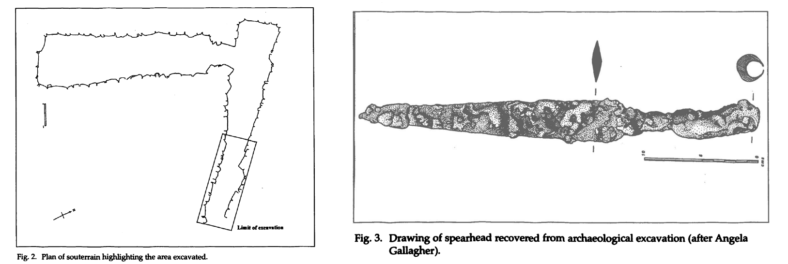
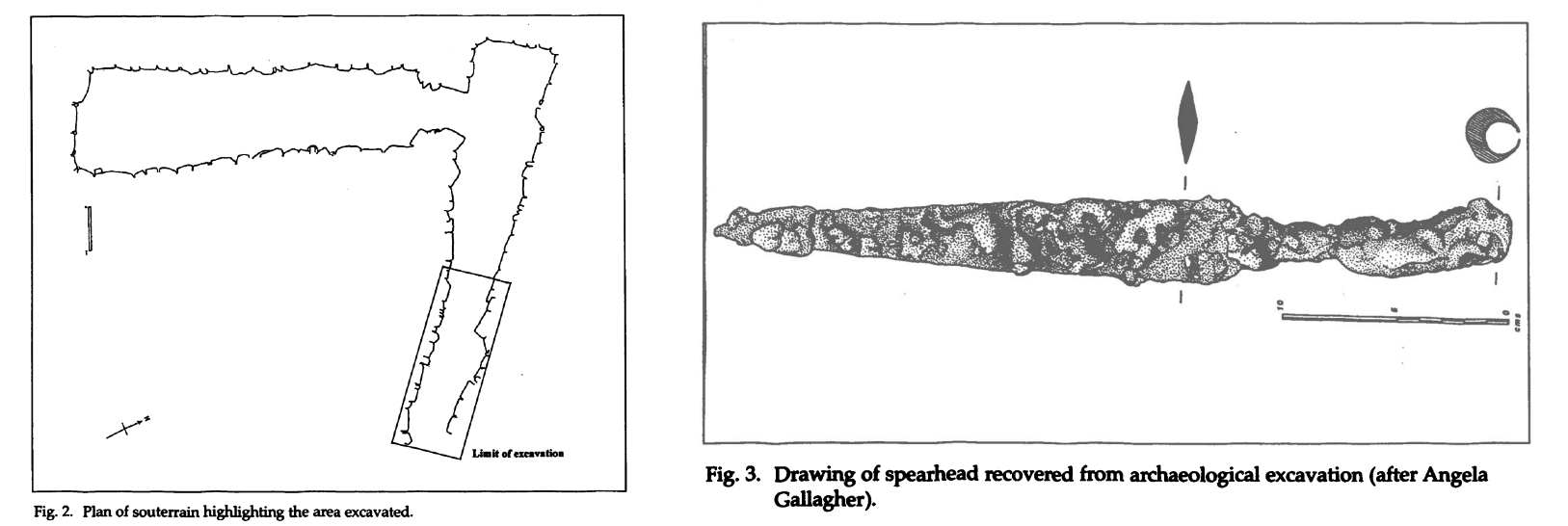
Though not mentioned in O’Donovan’s Field Name Books, a notable archaeological discovery was made in Graigue in September 1990 during work to extend the Loughrea Golf Course. According to Martin Fitzpatrick, a souterrain was discovered near the tenth green of the course, which consisted of an entrance passage and a main gallery. The entrance passage measured roughly 3.5 metres in length and was roofed by 4 large stone lintels. A narrow creep, approximately 1 metre by 1 metre, connected this passage to the main gallery, which extended about 8.6 metres and featured corbelled drystone walls constructed from uncut limestone. A corroded iron spearhead was recovered from the topsoil near the entrance, which has been dated to the 9th or 10th century AD. Unlike similar souterrains found in Loughrea, such as in the neighbouring townlands of Caheronaun and Kincullia, this souterrain was distinct as it was not found on a ringfort and appeared to have no surface enclosure associated with it.
Tithe Applotment Books
According to the Tithe Applotment Books (c. 1828), there were 4 named tithe-payers in Graigue: Mr. James Coghlan (Coughlan), Pierce (or Perce) Blake Esq., Edmund Nethercoal, and Michael Quirke.
James Coghlan (Coughlan) held 44 acres of land in the townland. 42 of his 44 acres was designated as 2nd Quality arable/pasture land, while his remaining 2 acres were designated as 3rd Quality land. His tithe amounted to £2 2s 10d, with £1 16s 5½d of said tithe to go to Rev. Denis Browne and 6s 4½d to go to Rev. Dean Hawkins.
Perce / Pierce Blake Esq. held 95 acres and 1 rood of land in the townland. 60 acres were designated 2nd Quality land, while 35 acres and 1 rood was designated 3rd Quality land. His tithe amounted to £3 14s 8¼d, with £3 3s 6½d of said tithe to go to Rev. Denis Browne and 11s 1¾d to go to Rev. Dean Hawkins.
Edmund Nethercoal held 38 acres of land in the townland. 14 acres were designated 2nd Quality land, 14 acres were designated 3rd Quality land, and 10 acres were designated 4th Quality land. His tithe amounted to £1 1s 6d, with 18s 3½d to go to Rev. Denis Browne and 3s 2½d to go to Rev. Dean Hawkins.
Michael Quirke held 26 acres of land in the townland. 13 acres was designated as 2nd Quality land, 7 acres was designated 3rd Quality land and 6 acres was designated as 4th Quality land. His tithe amounted to 17s 7d, with 14s 11½d to go to Rev. Denis Browne and 2s 7½d to go to Rev. Dean Hawkins.
Griffith’s Valuation (1847-1864) For Graigue
According to Griffith’s Valuation, the townland of Graigue (recorded as ‘Graigue’ in Griffith’s Valuation, but also known as Graig / Piperfield) comprised 275 acres, 3 roods and 16 perches. The Marquis of Clanricarde was the landowner and immediate lessor for the majority of the townland, with the exception of Burton Persse, who held a substantial portion of the land in fee. The townland was divided among 7 unique named occupants: Burton Persse, Robert D’Arcy, Patrick Neill, Paul Fallon, Thomas Fallon, Peter Donnellan and George Haigney. Names which appeared holding a house and office included Paul Fallon, Robert D’Arcy and Patrick Neill, while Thomas Fallon held a house only. Peter Donnellan and George Haigney held land only.
Burton Persse kept a portion of land for himself in fee, measuring 102 acres, 1 rood and 25 perches, and on which he had a herd’s house. He paid an annual valuation of £45 for the land and 5s for the buildings, with his total annual valuation of rateable property amounting to £45 5s. This was the largest individual holding within the townland.
The Marquis of Clanricarde leased tenements in Graigue to Robert D’Arcy, Patrick Neill, George Haigney, Thomas Fallon, Paul Fallon, and Peter Donnellan.
Robert D’Arcy leased 51 acres and 33 perches of land, on which he had a herd’s house. He paid an annual valuation rate of £22 for the land and 10s for the buildings, with his total annual valuation of rateable property amounting to £22 10s.
Patrick Neill leased 21 acres, 2 roods and 24 perches of land on which he had a house and an office. He paid an annual valuation rate of £11 5s for the land and 10s for the buildings, with his total annual valuation of rateable property amounting to £11 15s.
George Haigney leased 8 acres and 20 perches of land, that had no buildings on it, for which he paid an annual valuation rate of £3 5s for the land.
Thomas Fallon leased 1 acre, 1 rood and 22 perches of land on which he had a house. He paid an annual valuation rate of 15s for the land and 10s for the buildings, with his total annual valuation rate amounting to £1 5s.
Paul Fallon leased 68 acres, 1 rood and 30 perches of land, on which he had a herd’s house and an office. He paid an annual valuation of £33 for the land and 10s for its buildings, with his total annual valuation of rateable property amounting to £33 10s.
Peter Donnellan leased 1 acre, 2 roods and 2 perches of land, which had no buildings on it, for which he paid an annual valuation rate of £1 for the land.
Paul Fallon and Peter Donnellan also leased a portion of land 21 acres and 20 perches in size, shared jointly between them, on which they had a cottier’s house. They paid a combined annual valuation of £12 5s for the land and 5s for the buildings, with Fallon’s total annual valuation of rateable property coming to £5 7s and Donnellan’s amounting to £7 3s.
The total annual valuation of rateable property paid overall in Graigue was £128 10s for the land and £2 10s for the buildings, with the townland’s total valuation amounting to £131. The land in Graigue was valued at approximately 9s 4d per acre.
Nineteenth Century Census Information For Graigue
The following is census information compiled from 2 different sources. Firstly, The Census of Ireland For The Year 1851, Part 1, Showing The Area, Population And Number Of Houses By Townlands And Electoral Divisions (County Of Galway) (Page 65). Secondly, The Census Of Ireland, 1891, Part 1, Area, Houses, And Population: Also The Ages, Civil Or Conjugal Condition, Occupations, Birthplaces, Religion, And Education Of The People, Vol. IV. Province Of Connaught, No. 1 County Of Galway (Page 93).
1841: The population of Graigue in 1841 was 73 people, consisting of 37 males and 36 females. There was a total of 16 houses recorded, 15 of which were inhabited and 1 which was uninhabited.
1851: The population of Graigue in 1851 was 31 people, consisting of 16 males and 15 females. There were a total of 8 houses recorded, 6 of which were inhabited and 2 which were uninhabited. The Poor Law valuation for Graigue in 1851 was £113 5s.
1861: The population of Graigue in 1861 was 40 people, with a total of 7 houses recorded.
1871: The population of Graigue in 1871 was 19 people, with a total of 4 houses recorded.
1881: The population of Graigue in 1881 was 34 people, with a total of 5 houses recorded.
1891: The population of Graigue in 1891 was 19 people, consisting of 11 males and 8 females. There were a total of 4 houses, 3 of which were inhabited, as well as 19 out-offices recorded. In 1891, the total valuation of houses and land in Graigue was £128. The area of Graigue in 1891 was 275 acres, 3 roods and 16 perches.
1901 Census For Graigue
Overview Of Graigue (Loughrea Rural) In 1901
According to the 1901 Census, there were a total of 4 households in Graigue, 3 of which were inhabited. All inhabited households were classed as private dwellings. According to Form B1 of the House and Building Return, all were constructed of stone, brick or concrete walls and all had roofs made of wood, thatch or other perishable material. House 2 (Neill) and House 3 (Curly) were 2nd-class dwellings while House 1 (Bowes) was a 1st-class dwelling. House 1 had 9 rooms and 4 front windows, House 2 had 3 rooms and 3 front windows, and House 3 had 4 rooms and 2 front windows. Matthew Bowes was also recorded as the landholder for the fourth uninhabited household in the townland.
The Enumerator’s Abstract Return recorded a total of 16 individuals in Graigue at that time, consisting of 9 males and 7 females, with an average age of 31.2. Every individual was born in Co. Galway and was Roman Catholic. Literacy was 68.75% (11 individuals) able to read and write, 18.75% (3 individuals) able to read only, and 12.5% (2 individuals) recorded as unable to read. Bilingualism was present, with 37.5% (6 individuals) recorded as able to speak both Irish and English. The enumerator was Const. Andrew Murphy.
The heads of each household were Matthew Bowes, Patrick Neill and Patrick Curly. Matthew Bowes and Patrick Neill were the landholders for their households, while Michael Ryan was the landholder recorded for the Curly household. According to Form B2 of the Out-Offices and Farm-Steadings Return, there were a total of 25 out-offices in Graigue: 6 stables, 3 cow houses, 3 piggeries, 3 barns, 3 sheds, 2 fowl houses, a turf house, a calf house, a potato house, a coach house and a store.
Bowes Additional surnames: Fahey, Dooley, Howard
The head of the first household in Graigue was Matthew Bowes (64), a widower, who shared the home with his sons Patrick Bowes (29), Joseph Bowes (25), his daughter Brigid Bowes (24), and his niece, Agnes Fahey (17). Patrick (29) and Joseph (25) were recorded as ‘farmer’s sons’, Brigid (24) was recorded as a ‘farmer’s daughter’ and Agnes (17) was recorded as a scholar. Also residing within the household were two servants, Mary Dooley (50), a cook, and Patrick Howard (23), an agricultural labourer. Apart from Matthew (64), no other individual within the home was married.
Every member of the household was born in Co. Galway and was Roman Catholic. All could read and write, except for Mary Dooley (50), who could read only. Matthew Bowes (64) and Mary Dooley (50) were the only members recorded as able to speak both Irish and English.
They lived in a 1st-class, 9-roomed private dwelling with 4 front windows. The walls of the home were made of stone, brick or concrete, while wood, thatch, or other perishable material was used for roofing. There were 13 out-offices attached to the household: 4 stables, a coach house, a cow house, a piggery, a fowl house, a barn, a turf house, a potato house, a shed and a store. Matthew Bowes was the landholder. He also was recorded as the landholder for the fourth uninhabited household in Graigue.
The head of the second household in Graigue was Patrick Neil [Neill] (50), a farmer, who shared the home with his wife, Bridget (48), their sons Michael (13), John (10), Patrick (9), each recorded as scholars, as well as their daughters Delia (7) and Maryanne (3), all of whom were unmarried. Every member of the household was born in Co. Galway and was Roman Catholic. All could read and write, except for Delia (7) and Maryanne (3), who could not read. Only Patrick (50) and Bridget (48) were recorded as able to speak both Irish and English.
They lived in a 2nd-class, 3-roomed private dwelling with 3 front windows. The walls of the home were made of stone, brick or concrete, while wood, thatch, or other perishable material was used for roofing. There were 7 out-offices attached to the household: a stable, a cow house, a calf house, a piggery, a fowl house, a barn and a shed. Patrick Neill was the landholder.
The head of the third household in Graigue was Patrick Curly [Curley] (62), a shepherd, who shared the home with his wife, Bridget Curly (65). Both were born in Co. Galway, were Roman Catholic and were recorded as able to speak both Irish and English. Both were recorded as able to read only.
They lived in a 2nd-class, 4-roomed private dwelling with 2 front windows. The walls of the home were made of stone, brick or concrete, while wood, thatch, or other perishable material was used for roofing. There were 5 out-offices attached to the household: a stable, a cow house, a piggery, a barn and a shed. Michael Ryan was the landholder.
1911 Census For Graigue
Overview Of Graigue (Loughrea Rural) In 1911
According to the 1911 Census, there were a total of 3 households in Graigue, all classed as private dwellings. According to Form B1 of the House and Building Return, the walls of all houses were constructed of stone, brick or concrete, while wood, thatch or other perishable material was used for roofing. House 1 (Curly) and House 3 (Bowes) were 2nd-class dwellings, while House 2 (Neill) was a 3rd-class dwelling. House 1 had 4 rooms and 3 front windows, House 2 had 4 rooms and 2 front windows, and House 3 had 6 rooms and 3 front windows.
The Enumerator’s Abstract Return recorded a total of 19 individuals in Graigue at that time, comprising 11 males and 8 females, with an average age of 31.6. Every individual was born in Co. Galway and was Roman Catholic. Literacy was 73.7% (14 individuals) able to read and write, 10.5% (2 individuals) able to read only, and 15.8% (3 individuals) able to write only. Bilingualism was present, with 68.4% (13 individuals) recorded as able to speak both Irish and English. The enumerator was Const. Andrew Murphy.
The heads of each household were Patrick Curly [Curley], Patrick Neill and Patrick Bowes, who were also the landholders, except for Patrick Curly, whose landholder was Michael Ryan. According to Form B2 of the Out-Offices and Farm-Steadings Return, there were a total of 19 out-offices in the townland: 3 stables, 3 cow houses, 3 piggeries, 3 barns, 2 calf houses, 2 fowl houses, a coach house, a potato house and a shed.
Curly [Curley]
The head of the first household in Graigue was Patrick Curly [Curley] (75), a shepherd, who shared the home with his wife, Bridget (77), his daughter Mary (41), and his son James (35), all of whom were unmarried except Patrick and Bridget. Bridget (77) had been married to Patrick (75) for 43 years and had 5 children born alive, 4 of whom were still alive in 1911. Every member of the household was born in Co. Galway and was Roman Catholic. Mary (41) and James (35) could read and write, while Patrick (75) and Bridget (77) could read only. Only Patrick (75) and Bridget (77) were recorded as able to speak both Irish and English.
They lived in a 2nd-class, 4-roomed private dwelling with 3 front windows. The walls of the home were made of stone, brick or concrete, while wood, thatch or other perishable material was used for roofing. There were 6 out-offices attached to the household: a stable, a coach house, a cow house, a calf house, a piggery and a barn. Michael Ryan was the landholder.
Neill Additional surname: Finnerty
The head of the second household in Graigue was Patrick Neill (60), a farmer, who shared the home with his wife, Bridget (45), whom he had been married to for 23 years and had 7 children born alive, all of whom were still alive in 1911. They lived with their sons Michael (22), Patrick (17), Harry (6) and Thomas (6), as well as their daughters Delia (16) and Maryanne (13), all of whom were unmarried. A lodger was recorded within the home at the time, Mary Finnerty (50), a widow. Michael (22) and Patrick (17) were farmers, while Delia (16), Maryanne (13), Harry (6) and Thomas (6) were scholars. Every member of the household was born in Co. Galway and was Roman Catholic. All could read and write, except for Harry (6) and Thomas (6), who could write only. Similarly, all were recorded as able to speak both Irish and English.
They lived in a 3rd-class, 4-roomed private dwelling with 2 front windows. The walls of the home were made of stone, brick or concrete, while wood, thatch or other perishable material was used for roofing. There were 6 out-offices attached to the household: a stable, a cow house, a calf house, a piggery, a fowl house and a barn. Patrick Neill was the landholder.
Bowes Additional surnames: Fahey, Cronin,Broderick,Mullins
The head of the third household in Graigue was Patrick Bowes (36), a farmer, who shared the home with two of his cousins, Agnes Fahey (25) and Austia Fahey (13), a scholar, and his nephew Mattie (Matthew) Cronin (5), also a scholar. Also residing within the household were two servants, Henry Broderick (38) and Thomas Mullins (21), both recorded as farm servants. Every member of the household was born in Co. Galway, was Roman Catholic and was unmarried. All could read and write, except for Thomas Mullins (21), who could write only. Austia Fahey (13) and Henry Broderick (38) were the only members recorded as able to speak both Irish and English, as Patrick Bowes (36), Agnes Fahey (25), Mattie Cronin (5) and Thomas Mullins (21) were recorded as able to speak English only.
They lived in a 2nd-class, 6-roomed private dwelling with 3 front windows. The walls of the home were made of stone, brick or concrete, while wood, thatch or other perishable material was used for roofing. There were 7 out-offices attached to the household: a stable, a cow house, a piggery, a fowl house, a barn, a potato house and a shed. Patrick Bowes was the landholder.
1926 Census For Graigue
Overview Of Graigue (Loughrea Rural) In 1926
According to the 1926 Census, there were a total of 3 households in Graigue, all classed as private dwellings. According to Form B1 of the House and Building Return, House 1 (Curley) had 5 rooms, House 2 (O’Neill) had 4 rooms and House 3 (Bowes) had 3 rooms.
The heads of each household were Patrick Bowes, Patrick O’Neill and James Curley. Form B2 of the House and Building Return recorded a total of 10 individuals in Graigue at that time, 6 males and 4 females, with an average age of 43. The enumerator was Garda Mel Parsons.
The head of the first household in Graigue was Patrick Bowes (50), who shared the 5-roomed home with his cousin, Agnes Fahey (30). Patrick (50) was born in Loughrea, Co. Galway, while Agnes (30) was born in Kilnadeema [Killeenadeema], Co. Galway. Both were Roman Catholic and were unmarried. Patrick’s personal occupation was recorded as ‘farming only’, and for employment, ‘own account’ was recorded, meaning he worked on his own account and did not employ any paid persons for the purpose of business. Agnes Fahey (30) was recorded as a housekeeper, with ‘home duties’ annotated by the enumerator.
The head of the second household in Graigue was Patrick O’Neill (72), who shared the 4-roomed home with his wife Bridget (58), their sons Michael (36), Patrick (30) and Thomas (20), as well as their daughter Bridget (28), all of whom were unmarried. Patrick (72) and Bridget (58) had been married for 37 years and had 5 children born alive. Every member of the household was Roman Catholic and born in Graigue, Loughrea, Co. Galway. Patrick (72) was a farmer and was employed at his own account. The occupation recorded for each of his sons was ‘assisting on father’s farm’, while for his wife Bridget (58) and daughter Bridget (28), ‘home duties’ was recorded as their occupation. All were recorded as able to speak both Irish and English, except for Michael (36) and Patrick (30), who spoke English only.
The head of the third household in Graigue was James Curley (50), who shared the 3-roomed home with his sister, Mary Curley (56). Both were Roman Catholic, were unmarried and were born in Graigue, Loughrea, Co. Galway. Mary (56) was a housekeeper, while James (50) was a herdsman, who worked for another farmer, Thomas Ryan. Each was recorded as able to speak English only.
Comparing The Census Records For Graigue
Comparing the nineteenth century census records with the 1901, 1911 and 1926 census records for Graigue reveals a significant pattern of depopulation and decline in the number of houses. In 1841, the population of the townland stood at 73 people across 16 houses. By 1851, the population had fallen to just 31 people, a decline of 57% in the span of only a decade. This reduction was a likely a consequence of the Great Famine, which devastated much of the west of Ireland during the late 1840s. The number of houses also decreased sharply, from 16 in 1841 to 8 in 1851, with the number of inhabited houses falling from 15 to 6. The population continued to fluctuate in the decades that followed, never recovering to pre-famine levels. By 1861, the population had risen slightly to 40 people, only to fall again to 19 by 1871. A modest recovery followed in 1881, with 34 people recorded, but by 1891 the population had declined once more to 19 people. The number of houses followed a similar trajectory, dropping from 7 in 1861 to 4 in 1871, rising to 5 in 1881, and then falling to 4 houses by 1891.
By the early twentieth century, the population stabilised somewhat, with the 1901 Census recording 16 individuals across 3 inhabited households. The population rose slightly to 19 individuals by 1911, before declining to just 10 individuals by 1926. Several other observations can be made from comparing the census records. Surname variations are evident in the Neill household, which was recorded as ‘Neil’ in 1901, ‘Neill’ in 1911 and ‘O’Neill’ in 1926. Additionally, literacy in the townland improved during this period, rising from 68.75% in 1901 to 73.7% in 1911. Bilingualism experienced a notable increase, rising from 37.5% in 1901 to 68.4% in 1911. However, in the 1926 Census, only the O’Neill household was recorded as bilingual, with the Curley and Bowes households recorded as able to speak English only.
No Comments
Add a comment about this page