
Barnaboy (An Beárna Buidhe)
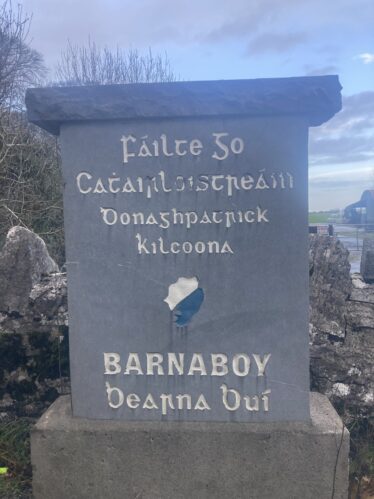
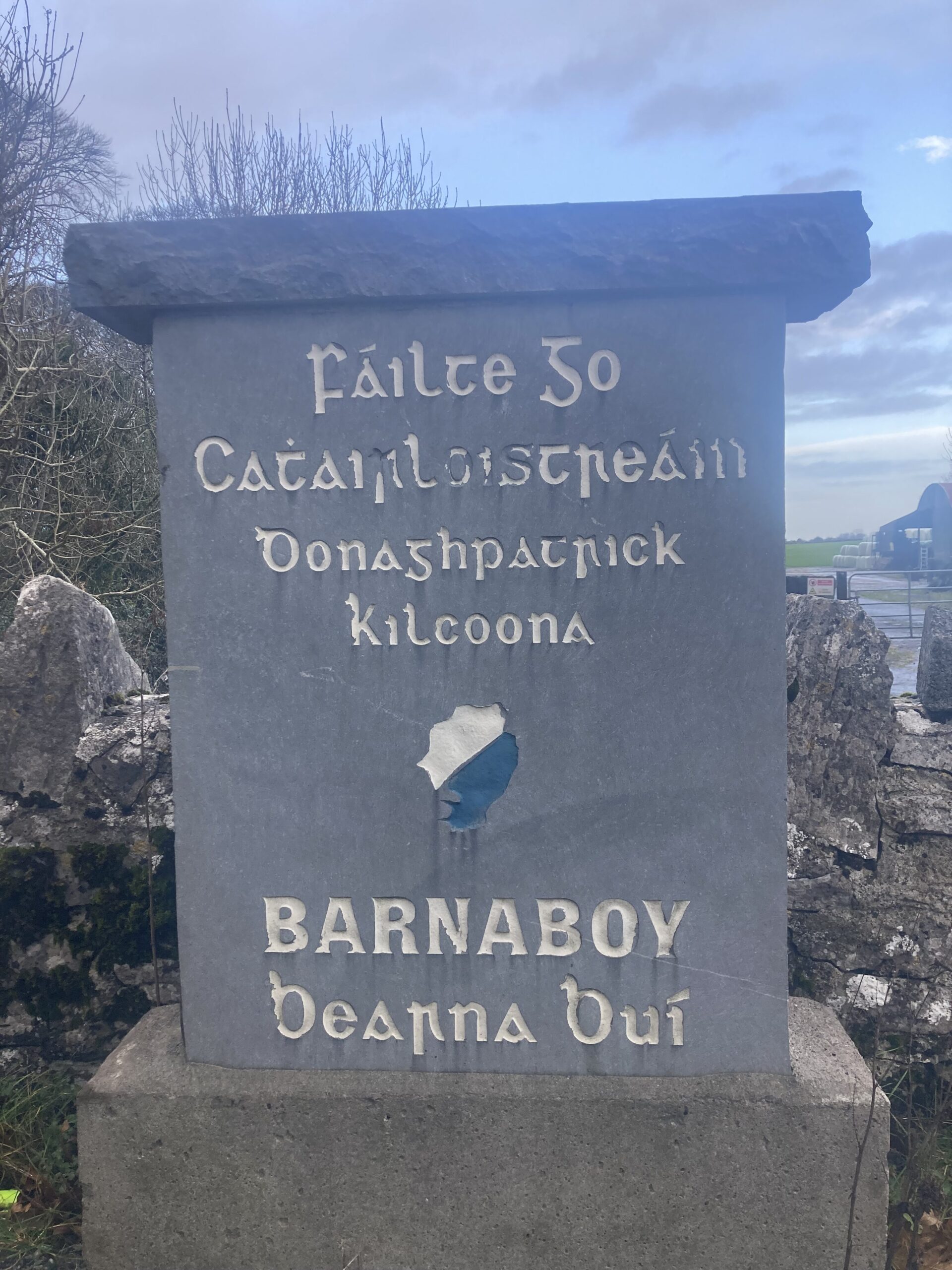
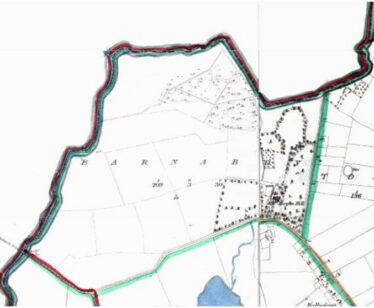
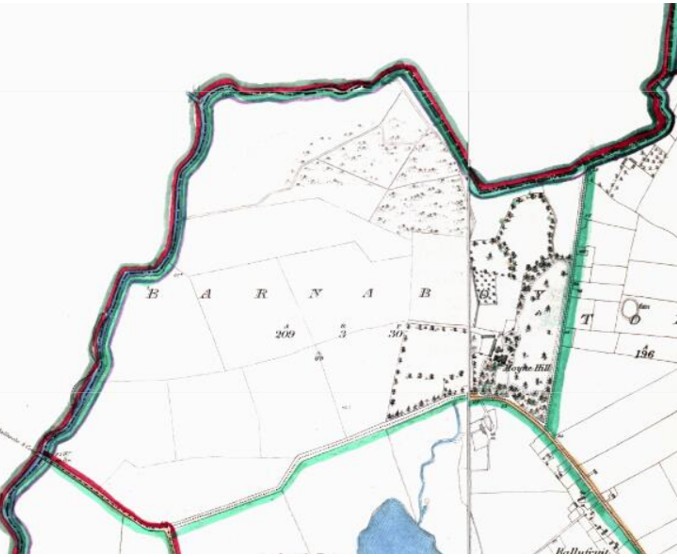
The name Barnaboy comes from the Irish Beárna Buidhe, meaning the yellow gap. It is situated in the civil parish of Kilkilvery, Barony of Clare. It is located in the west of the parish and is bounded on the east by Tonroe, on the west by Moyne and Toorard, on the south by Ballyfruit and Cordarragh and on the north by Carrowbeg South. (Source: Galway Library).
Irish name: Beárna Buidhe
English name: Barnaboy
Meaning: The Yellow Gap
Bearna/Barna: Gap
Buide/Bui: Yellow
Area: 209 acers, 1 rood and 2 perches
Field names:
Civil Parish: Kilkilvery
Barony: Clare
O’Donovan’s Field Name Books
As part of the Ordnance Survey of Ireland, from 1830 to 1842, John O’Donovan helped to collect and record the Irish form of townland names throughout the country. Information for each townland was collected and written into the Name Book along with information relating to land quality, crops and housing. (Source: Timeline Genealogy)
Other names: Barnaboy, Beárna Buidhe, Barnabwee (By. Surveyors Sketch Map), Barnabwee) County Cess Collector), Barnabwee (Mearsman), Barnabwee or Ballyfruit (Proctor), Barnawee (Irish mode Rev. John Molloy, P.P.), Blakehill (Rev. John Molloy, P.P.)
Description: Proprietor Charles Blake, Esq., Merlin Park, Co. Galway. All let to Pat Lynch, Esq., Clogher, Co. Mayo, under a lease of 21 years. Rent 55 shillings per acre. On the western extremity of this townland stands the handsome cottage of Barnabwee or Moyne Hill, commanding a prospect of the picturesque country around etc. Co. Cess 14d. paid per acre half yearly. No antiquities.
Situation: In the North West corner of the parish, bounded on the North and West by the parish of Shruil, Co. Mayo, South by the parish of Killursa and townland Ballyfruit and on the East by Thoneroe. In the Barony of Clare and County of Galway.
Other placenames in this townland
Moyne Hill “A gentleman’s seat” (house) located in the east part of the townland of Barnabwee with the Irish meaning of ‘a small plain’.
The Down Survey
The first national-scale survey of its kind in the world, the Down Survey, taken in the years 1656 -1658, sought to acurately map the land in Ireland in order to facilitate its transfer from Irish Catholics to English Protestants after the Cromwellian conquest. (Source: Trinity College Dublin)
1641 (pre-Cromwell) states that the owner(s) of the townland of Barnaboy (Referred to as Ballygowne in the Down Survey of Ireland, in the Parish of Killkillurey in the county of Galway, Barony of Clare) was the Edmund Skerret (Catholic). The Down Survey map of 1670 (post-Cromwell) shows that the owner(s) was Sir Oliver St. George (Protestant).
16 plantation acres was deemed unprofitable
64 plantation acres was deemed profitable land
64 plantation acers were deemed plantation land
Tithe Applotment Book 1826
The Tithe Applotment Books were compiled between 1823 and 1837 in order to determine the amount which occupiers of agricultural holdings over one acre should pay in tithes to the Church of Ireland. The land was measured in Irish acres, or plantation acres at the time. This equated to 1.698 English acres.
There were no records found for Barnaboy.
Valuation Office Books 1824-1856: House & Field Books
The valuation of Ireland was a cadastral survey made for the purpose of levying tax on property. A valuation price was put on every piece of property in the country and this became the basis on which local tax was charged, at a rate per pound of valuation. (Source: National Archives)
The 1843 Field Books show the following as occupier in Barnaboy as Patrick Lynch (17 August 1843). (Source: The National Archives)
Patrick Lynch occupied a house and offices with a valuation of £19.
The total amount of land valued in Barnaboy by the Griffith’s Valuation was 209 acers, 3 roods and 30 perches which had an initial valuation of £154 and 8 shillings and 8 pence which was reduced to £140 and 18 shillings. The valuator was David Williamson.
The 1845 House Books show the following as occupier in Barnaboy as William S. Carter (24 June 1845). (Source: The National Archives)
William S. Carter occupied a house with a kitchen porch, kitchen, turf house, laundry, dairy, stables, car house, cow stables, forge, piggery and privy which had an initial valuation of £32 and 19 shillings and 3 pence, which after several deductions was reduced to £19. The valuator was David Williamson.
The 1853 House Books show the following as occupier in Barnaboy as William S. Carter (30 September 1853). (Source: The National Archives)
William S. Carter occupied a house and offices “worth £15. 0 .0.”. No actual valuation was stated under the ‘Amount’ heading.
1855 Griffith’s Valuation
Between 1847 and 1864, Richard Griffith was responsible for carrying out the Primary Valuation of Tenements (generally referred to as Griffith’s Valuation because of his role in the project). The aim of the valuation was to produce a uniform guide to the relative value of land throughout the whole of Ireland in order to decide liability to pay the Poor rate (for support of the poor and destitute within each Poor Law Union). The project required Griffith and a team of valuers to determine the value of every piece of land and property in the country enabling every occupiers’ tax due to be assessed. The information they collated covering all 32 counties was compiled into over 300 volumes and published over a period of 17 years. (Source: Find My Past)
Griffith’s Valuation records the following occupier in Barnaboy as William S. Carter. (Source: Ask About Ireland).
William S. Carter occupied the following properties “In Fee”; a house and offices with lands totalling 200 acers, 3 roods and 30 perches which had a valuation of £145. The valuation of the house and offices was £15. *
* Lands held ‘in fee’ were freehold tenures, derived from a grant from the Crown.
Population Statistics
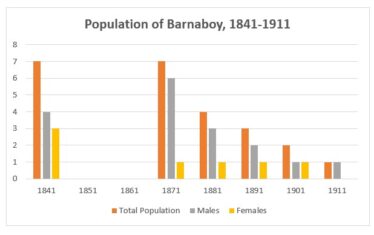
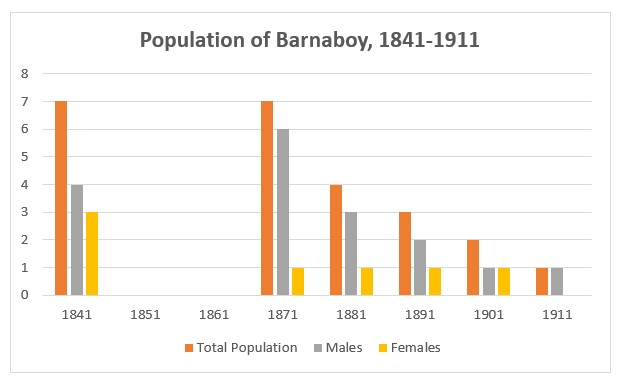
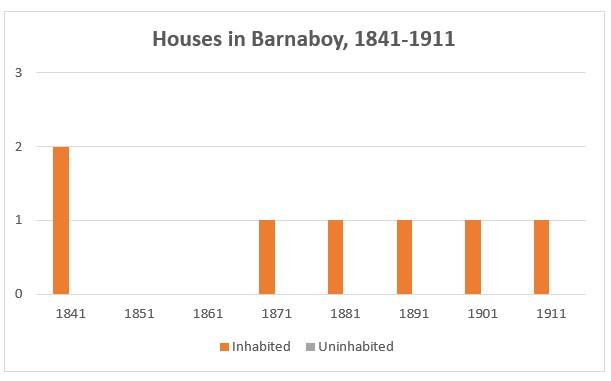
The following statistics are from the census return records from 1842 to 1891 and the National Archives census returns for 1901 and 1911. (Source: Histpop)
1841: 1 house, 3 people (2 males and 1 females)
1851: 1 house, 4 people (3 males and 1 females)
1861: 1 house, 7 people (4 males and 3 females)
1871: 1 house, 7 people (3 males and 4 females)
1881: 1 house, 6 people (2 males and 4 females)
1891: 1 house, 6 people (2 males and 4 females)
1901: 1 house, 3 people (1 male and 2 females)
1911: 1 house, 9 people (3 males and 6 females)
1901 Census
The 1901 Census of Ireland records the following 3 individuals living in 1 household in Barnaboy. (Source: National Archives)
1. Arthur Wm Carter (50), unmarried, lived with boarder Laura Jones (38) and Servant Mary Toole (17). All householders were born in England with the exception of Mary Toole who was born in Co Galway. Arthur Wm Carter and Laura Jones were members of the church of Ireland while Mary Toole was a Roman Catholic. Arthur’s occupation was listed as a Farmer, Laura’s occupation was listed as a House Keeper, while Mary Toole’s occupation was listed as a General Servant Domestic. All householders could read and write. None of the householders were listed as Irish speakers.
1911 Census
There was 1 house in Barnaboy with a total of 9 individuals recorded in the 1911 Census of Ireland. (Source: National Archives)
1. Thomas A. McDonagh (40) lived with his wife of 8 years Mary (31), daughter Mary Rhattigan (32), daughters Mary E. (6), Kathleen M. (4), Ailen P. (3) and Gladys J. (2), sons Francis J.A. (5) and Thomas C.A. (11 months) and Servant Delia Quirk (26). All householders were born in Co Galway and all were Roman Catholic. Thomas A’s occupation was listed as a Magistrate and Farmer, Delia Quirk’s occupation was listed as a Domestic Servant. No occupation was listed for the other householders. All householders could read and write with the exception of Francis J.A., Kathleen M., Ailen P., Gladys J. and Thomas C.A. Only Thomas A. and Delia could speak both Irish and English. Thomas a. and Mary had 6 children, all of whom were still living in 1911.
No Comments
Add a comment about this page