
Ballinvoher (Baile an Bhóthair)
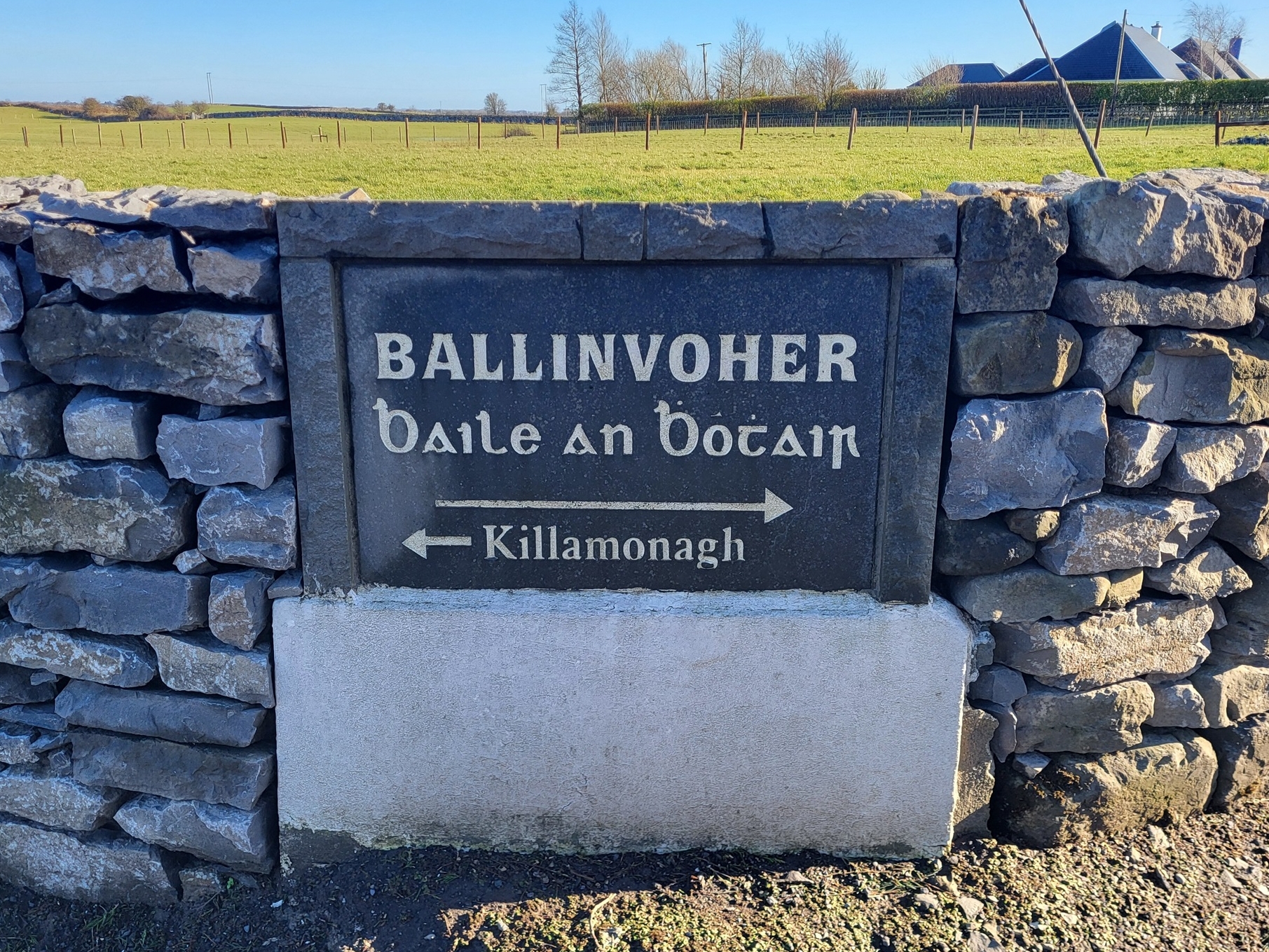
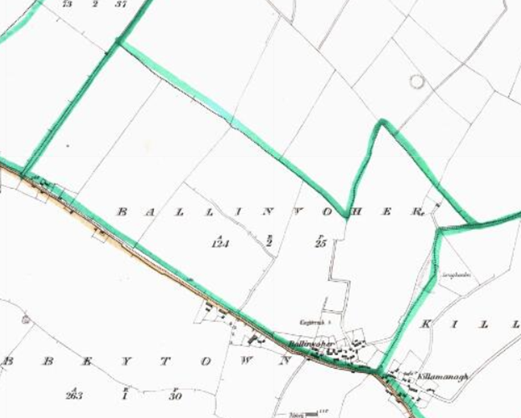
The name Ballinvoher comes from the Irish Baile an Bhóthair, meaning the townland of the road. It is situated in the civil parish of Donaghpatrick, Barony of Clare. It is located in the east side of the parish and is bounded on the east by Killamanagh and Bellangarraun, on the west by Abbeytown and Ralusk. (Source: Galway Library)
Irish name: Baile an Bhóthair
English name: Ballinvoher
Meaning: The townland of the road
Baile: Townland
Bóthar: Road
Area: 124 Acres, 2 roods, and 25 perches
Field names:
Civil Parish: Donaghpatrick
Barony: Clare
O’Donovan’s Field Name Books
As part of the Ordnance Survey of Ireland, from 1830 to 1842, John O’Donovan helped to collect and record the Irish form of townland names throughout the country. Information for each townland was collected and written into the Name Book along with information relating to land quality, crops and housing. (Source: Timeline Genealogy)
Other names: Ballinlovel (County Map), Balliniwoher (Local), Ballinwoher (Mearsman) (Rev. John Molloy, P.P.) Ballinlover (Larkin), Ballenlabane (Down Survey), Ballinooher (Valuation Office Books)
Description: The property of William Murphy, Esq. of Dublin. Agent Thomas Burke, Carramore, let to tenants at about 17s. and 6d. per acre. Farms from 1 to 7 acres. Soil middling. The village of Ballinvoher is situated in the S.E. corner of the townland. Religion all Roman Catholics. The only remarkable thing in this townland is a large standing stone called Clogh Brack. It is like an antiquity.
Situation: A central townland bounded on the North by the townland of Ballygurraun, West by Ralusk, South by Abbeytown and on the East by Killimannagh. In the Barony of Clare and County of Galway.
Other placenames in this townland
Cloghbrack Translating to ‘standing stone’ or ‘speckled stone’, this name denotes a standing stone situated in the south side of Ballinvoher townland. Other forms of this placename include Cloghbrack, Cloch Bhreac and Cloughbrack Local
The Down Survey
The first national-scale survey of its kind in the world, the Down Survey, taken in the years 1656 -1658, sought to acurately map the land in Ireland in order to facilitate its transfer from Irish Catholics to English Protestants after the Cromwellian conquest.
1641 (pre-Cromwell) states that the owner(s) of the townland of Ballinvoher (Ballenabane in the Parish of Kilnamannagh and Donaghpatrick in the county of Galway, Barony of Clare) was the Edmund Skerret (Catholic). The Down Survey map of 1670 (post-Cromwell) shows that the owner was Sir Edward Ormsby (Protestant). (Source: Trinity College Dublin)
208 acres of land was specified with all 208 acres deemed profitable land.
Tithe Applotment Book 1826
The Tithe Applotment Books were compiled between 1823 and 1837 in order to determine the amount which occupiers of agricultural holdings over one acre should pay in tithes to the Church of Ireland. The land was measured in Irish acres, or plantation acres at the time. This equated to 1.698 English acres.
The Tithe Applotments returns for Ballinvoher places the townland in Belclare parish.
The Tithe Applotment Books record Thomas Glynn, Patt Reiley, James Monaghan, Thomas Reiley, John Mannion, Daniel Murphy, John Coghlan, James Reiley and James Cullinane as occupiers in Ballinvoher totalling 31- and three-quarter acres. (Source: The National Archives)
Thomas Glynn occupied land totalling 4 acres, 1 rood and 2 and a half perches which had a valuation of 4 shillings and 10 pence. Patt Reiley occupied land totalling 4 acres, 1 rood and 2 and a half perches which had a valuation of 4 shillings and 10 pence. James Monaghan occupied land totalling 2 and 3 quarter acres, 1 rood and 2 and a half perches which had a valuation of 3 shillings and 3 pence. Thomas Reiley occupied land totalling 2 acres, 1 rood and 2 and a half perches which had a valuation of 2 shillings and 5 pence. John Mannion occupied land totalling 5 acres, 1 rood and 2 and a half perches which had a valuation of 6 shillings and 1 half pence. Daniel Murphy occupied land totalling 6 acres, 1 rood and 2 and a half perches which had a valuation of 7 shillings and 3 pence. John Coghlan occupied land totalling 3 and 3 quarter acres, which had a valuation of 2 shillings and 6 pence. James Reiley occupied land totalling 2 and 3 quarter acres which had a valuation of 1 shilling and 10 pence. James Cullinane occupied land totalling 1 and a half acres which had a valuation of 1 shilling.
1851 Old Age Pension Census Search Forms
There were no records found for Ballinvoher.
Valuation Office Books 1824-1856: House & Field Books
The valuation of Ireland was a cadastral survey made for the purpose of levying tax on property. A valuation price was put on every piece of property in the country and this became the basis on which local tax was charged, at a rate per pound of valuation. (Source: National Archives)
The 1853 House Books show the following as house occupiers in Ballinooher/Ballinvoher as John O’ Brien, Mary Joyce, Mary Galway and Miles Sweeny (26 September). (Source: National Archives)
John O’Brien occupied a Herd’s House which had an initial valuation of 5 shillings which was reduced to 3 shillings. Mary Joyce occupied a House which had an initial valuation of 10 shillings which was reduced to 5 shillings. Mary Galway occupied a House which had an initial valuation of 15 shillings which was reduced to 8 shillings. Miles Sweeny occupied a House which had an initial valuation of £1 and 10 shillings which was reduced to 15 shillings.
In 1854 the House Books shows the following as house occupiers in Ballinvoher (Ballinooher): Michael Moran, John Moran, Luke Burke, Michl Moran & John Moran, John Quin, John Quin Jr, Thomas Quin, Stephen Connor, Thomas Burke, Patrick Moran and Patrick Gill (all 24 February 1854). (Source: National Archives)
Michael Moran occupied a house and offices with an initial valuation of £1 and 18 shillings which was reduced to £1. John Moran occupied a house and offices with an initial valuation of £1 and 1 shilling which was reduced to £1. Luke Burke occupied a house and offices with an initial valuation of £1 and 18 shillings which was reduced to £1. Michl Moran & John Moran occupied a house and offices with an initial valuation of £1 and 13 shillings which was reduced to 16 shillings. John Quin occupied a house and offices with an initial valuation of £2 and 11 shillings which was reduced to £1 and 5 shillings. John Quin Jr occupied a house and offices with an initial valuation of £2 and 6 shillings which was reduced to £1 and 5 shillings. Thomas Quin occupied a house and offices with an initial valuation of £1 and 18 shillings which was reduced to £1. Stephen Connor occupied a house with an initial valuation of £1 and 13 shillings which was reduced to 6 shillings. Thomas Burke occupied a house with an initial valuation of £1 and 8 shillings which was reduced to 15 shillings. Patrick Moran occupied a house and offices with an initial valuation of £1 and 11 shillings which was reduced to 15 shillings. Patrick Gill occupied a house and offices with an initial valuation of 8 shillings which was reduced to 4 shillings.
A Michael Morgan and John Morgan are named on the valuation website as occupiers in the 1854 House Book for Ballinvoher (Ballinooher). There is no recording of either individual on the original scanned document. This may have been a mistake in the transcription and Michael and John Morgan are in actual fact Michael and John Moran.
1855 Griffith’s Valuation
Between 1847 and 1864, Richard Griffith was responsible for carrying out the Primary Valuation of Tenements (generally referred to as Griffith’s Valuation because of his role in the project). The aim of the valuation was to produce a uniform guide to the relative value of land throughout the whole of Ireland in order to decide liability to pay the Poor rate (for support of the poor and destitute within each Poor Law Union). The project required Griffith and a team of valuers to determine the value of every piece of land and property in the country enabling every occupiers’ tax due to be assessed. The information they collated covering all 32 counties was compiled into over 300 volumes and published over a period of 17 years. (Source: Find My Past)
Griffith’s Valuation records the following occupiers in Ballinvoher as by Luke Burke, Thomas Burke, Stephen Connor, John Moran, Michael Moran, Ml. Moran, Patrick Moran, John Quin, John Quin Jr., Thomas Quin and Michael Roche. (Source: Ask About Ireland)
Michael Roche occupied a land totalling 17 acres which had a valuation of £10. Michael Moran, John Moran, Luke Burke, Ml. and John Moran, John Quin, John Quin Jr., Thomas Quin, Stephen Connor, Thomas Burke and Patrick Moran were co-tenants in land totalling 107 acres, 2 roods and 23 perches. The valuation of Michael Moran’s co-tenancy was £8 and 5 shillings, in addition Michael Moran occupied a house and offices with a valuation of 15 shillings. The valuation of John Moran’s co-tenancy was £3 and 10 shillings, in addition John Moran occupied a house and offices with a valuation of 15 shillings. The valuation of Luke Burke’s co-tenancy was £4 and 15 shillings, in addition Luke Burke occupied a house and offices with a valuation of 10 shillings. The valuation of Ml. and John Moran’s co-tenancy was £10 and 10 shillings, in addition John Moran occupied a house and offices with a valuation of 15 shillings. The valuation of John Quin’s co-tenancy was £10 and 15 shillings, in addition John Quin occupied a house and offices with a valuation of 15 shillings. The valuation of John Quin Jr’s co-tenancy was £9 and 10 shillings, in addition John Quin Jr. occupied a house and offices with a valuation of 15 shillings. The valuation of Thomas Quin’s co-tenancy was £4 and 5 shillings, in addition Thomas Quin occupied a house and offices with a valuation of 15 shillings. The valuation of Stephen Connor’s co-tenancy was 10 shillings, in addition Stephen Connor occupied a house with a valuation of 5 shillings. The valuation of Thomas Burke’s co-tenancy was 5 shillings, in addition Thomas Burke occupied a house with a valuation of 10 shillings. The valuation of Patrick Moran’s co-tenancy was 10 shillings, in addition Patrick Moran occupied a house with a valuation of 10 shillings. The immediate lessor for all properties recorded in the Griffith’s Valuation for Ballinvoher was Rep. John W. Murphy.
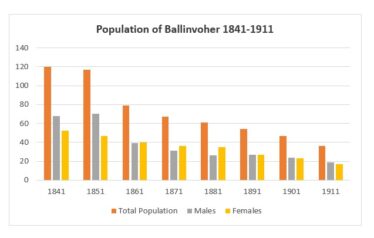
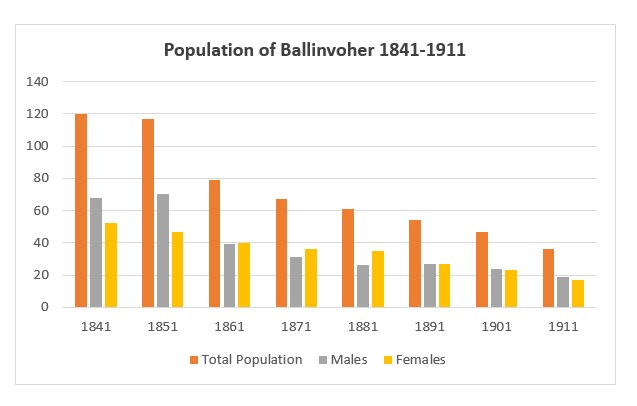
Population Statistics
The following statistics are from the census return records from 1842 to 1891 and the National Archives census returns for 1901 and 1911. (Source: Histpop)
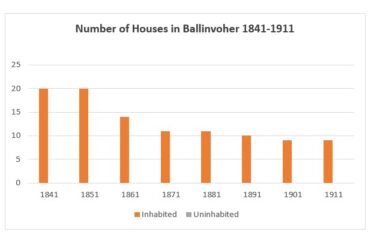
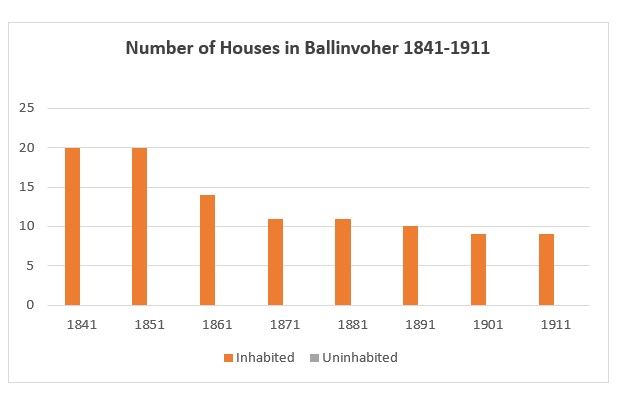
1841: 20 houses, 120 people (68 males and 52 females)
1851: 20 houses, 117 people (70 males and 47 females)
1861: 14 houses, 79 people (39 males and 40 females)
1871: 11 houses, 67 people (31 males and 36 females)
1881: 11 houses, 61 people (26 males and 35 females)
1891: 10 houses, 54 people (27 males and 27 females)
1901: 9 houses, 47 people (24 males and 23 females)
1911: 9 houses, 36 people (19 males and 17 females)
1901 Census
The 1901 Census of Ireland records the following 47 individuals living in 9 households in Ballinvoher. (Source: National Archives)
1. Luke Burke (78) lived with his wife Mary Sr. (68), son Thomas (30) and daughter Mary Jr. (33). All householders were born in Co Galway and all were Roman Catholic. Luke’s occupation was listed as a Farmer. Mary Sr’s occupation was listed as a Farmer’s Wife. Thomas’ occupation was listed as Farmer’s Son. Mary Jr’s occupation was listed as a Farmer’s Daughter. All householders could read and write with the exception of Mary Sr. who could read only. All householders could speak Irish and English.
2. Michael Moran (56) lived with his wife Margaret (50), sons John (25), Michael Jr. (12) and Patrick (9), daughters Winnie (18), Mary A. (17), Nora (16) and Julia (14). All householders were born in Co Galway and all were Roman Catholic. Michael Sr’s occupation was listed as a Farmer. Margaret’s occupation was listed as a Farmer’s Wife. John, Michael Jr. and Patrick’s occupation was listed as Farmer’s Son. Winnie, Mary A., Nora and Julia’s occupation was listed as a Farmer’s Daughter. All householders could read and write. All householders could speak Irish and English with the exception of Patrick who spoke English only.
3. Anthony Hughes (46) a widower, lived with his sons Patrick (8) and John (7) and daughter Delia (9). All householders were born in Co Galway with the exception of Anthony who was born in Co Mayo. All householders were Roman Catholic. Anthony’s occupation was listed as a Farmer, Patrick, John and Delia were listed as scholars. All householders could read and write with the exception of Anthony who could read only. All householders could speak Irish and English.
4. Michael Moran (75) lived with his wife Mary (60), son in law Michael McDonagh (35), daughter Kate McDonagh (32) and grandson John McDonagh (6 months). All householders were born in Co Galway and all were Roman Catholic. Michael Moran’s and Michael McDonagh’s occupation was listed as a Farmer. Mary Moran’s and Kate McDonagh’s occupation was listed as a Farmer’s Wife. John McDonagh’s was listed as Farmer’s Son. All householders could read and write with the exception of Michael Moran and John McDonagh. All householders could speak Irish and English with the exception of John McDonagh.
5. Ellen Connor (60) lived with her sister Bridget (56). Both householders were born in Co Galway and both were Roman Catholic. Ellen’s occupation was listed as a Farmer. Bridget’s occupation was listed as Farmer’s Sister. Neither householder could read or write. Both householders spoke Irish only.
6. John Quinn (50) lived with his wife Bridget (45), sons John Jr. (28) and Martin (19), daughters Mary (20) and Nora (15). All householders were born in Co Galway and all were Roman Catholic. John Sr’s occupation was listed as a Farmer. Bridget’s occupation was listed as a Farmer Wife. John and Martin’s occupation was listed as Farmer’s Son. Mary and Nora’s occupation was listed as a Farmer’s Daughter. All householders could read and write with the exception of Bridget who could read only. All householders could speak Irish and English.
7. Patrick Quinn (57) lived with his wife Bridget Sr. (45), brother Peter (60), daughters Mary (24), Bridget Jr. (18) and Maggie (12), sons Thomas (23), Patrick Jr. (15) and Michael (12) and niece Delia Mulroe (6). All householders were born in Co Galway and all were Roman Catholic. Patrick Sr’s occupation was listed as a Farmer. Bridget Sr’s occupation was listed as a Wife. Peter’s occupation was listed as a Farmer’s Brother. Thomas’ occupation was listed as Farmer’s Son. Mary and Bridget Jr’s occupation was listed as a Farmer’s Daughter. Patrick Jr., Michael, Maggie and Delia were listed as scholars. All householders could read and write with the exception of Bridget Sr. who could read only. All householders could speak Irish and English.
8. Michael Quinn (58) lived with his wife Nora (52), sons Patrick (26) and John (20) and daughter Maggie (17). All householders were born in Co Galway and all were Roman Catholic. Michael’s occupation was listed as a Farmer. Nora’s occupation was listed as a House Keeper. Patrick and John’s occupation was listed as Farmer’s Son. Maggie’s occupation was listed as a Farmer’s Daughter. All householders could read and write. All householders could speak Irish and English.
9. Mary Moran a widow (71) lived with her son Owen (35). Both householders were born in Co Galway and both were Roman Catholic. Mary’s occupation was listed as a Farmer. Owen’s occupation was listed as Farmer’s Son. Both householders could read and write. Both householders could speak Irish and English.
There were six second class houses and three third class houses. All houses had a roof of thatched, wood or other perishable material. All houses had walls constructed of either brick, stone or concrete. All six second class house had three front windows. All three third class houses had two front windows. There were seven stables, eight cow houses, four calf houses, eight piggeries, seven fowl houses and six barns.
1911 Census
There were 9 houses in Ballinvoher with a total of 36 individuals recorded in the 1911 Census of Ireland. (Source: National Archives)
1. Mary Moran (79) a widow, lived with her son Owen (45). Both householders were born in Co Galway and both were Roman Catholic. Mary’s occupation was not listed. Owen’s occupation was listed as Farmer’s Son. Both householders could not read or write. Both householders could speak Irish and English.
2. Patrick Quinn (71) lived with his wife of 37 years Bridget (67), brother Peter (78), sons Thomas (34), Patrick Jr. (26) and Michael (21), daughter Margaret (21), niece Nora D. Martyn (2). All householders were born in Co Galway and all were Roman Catholic. Patrick Sr’s occupation was listed as a Farmer. Thomas and Michael’s occupation was listed as Farmer’s Son. Patrick Jr’s occupation was listed as a Black Smith. Margaret’s occupation was listed as a Farmer’s Daughter. Nora D Martyn’s occupation was listed as a Carpenter’s Daughter. Peter’s occupation was listed as a Farmer’s Brother. No occupation was listed for Bridget. Patrick Sr., Patrick Jr., Michael and Margaret could read and write. All householders could speak Irish and English. Patrick Sr. and Bridget had 8 children, 7 of whom were still living in 1911.
3. Honor Quinn (69) a widow, lived with her sons Martin (43), Patrick (41) and John (31). All householders were born in Co Galway and all were Roman Catholic. Honor’s occupation was listed as a Farmer. Martin, Patrick and John’s occupation was listed as Farmer’s Son. All householders could read and write with the exception of Honor. All householders could speak Irish and English.
4. John Quinn (70) lived with his wife of 41 years Bridget (70), son John Jr. (35) and daughter Norah (29). All householders were born in Co Galway and all were Roman Catholic.John Sr. and Bridget’s occupation was listed as a Farmer. John Jr’s occupation was listed as Farmer’s Son. Norah’s occupation was listed as a Farmer’s Daughte. John Jr. and Norah could read and write. All householders could speak Irish and English. John Sr. and Bridget had 8 children, all of whom were still living in 1911.
5. Bridget Connor (72) was unmarried and was born in Co Galway and was a Roman Catholic. Bridget’s occupation was not listed. Bridget could not read or write and spoke Irish only.
6. Michael Moran (72) lived with his wife of 36 years Margaret (64), sons John J. (35) and Michael Jr. (23), daughters Mary A. (27) and Julia E. (24). All householders were born in Co Galway and all were Roman Catholic. Michael Sr., John J. and Michael Jr’s occupation was listed as a Farmer. No occupation was listed for the remaining householders. All householders could read and write. All householders could speak Irish and English. Michael Sr. and Margaret had 7 children, all of whom were still living in 1911. Micharl Jr. is listed as being married for 1 year.
7. Anthony Hughes (55) a widower, lived with his sons Patrick (18) and John (17) and daughter Delia K. (19). All householders were born in Co Galway and all were Roman Catholic. Anthony, Patrick and John’s occupation was listed as a Farmer. No occupation as listed for Delia K. All householders could read and write. All householders could speak Irish and English. Prior to his wife’s death, Anthony had been married for 21 years.
8. Michael McDonagh (46) lived with his wife of 11 years Kate (48) and (her) mother Mary Moran (75). All householders were born in Co Galway and all were Roman Catholic. Michael’s occupation was listed as a Farmer. No occupation was listed for Kate or Mary. All householders could read and write. All householders could speak Irish and English.
9. Mary Burke (78) a widow, lived with her son Thomas (47), daughter in law Bridget (34) and daughter Mary Jr. (50). All householders were born in Co Galway and all were Roman Catholic. Thomas’ occupation was listed as a Farmer. No occupation was listed for the remaining householders. All householders could read and write with the exception of Mary Sr. All householders could speak Irish and English. Prior to her husband’s death, Mary had been married for 56 years. Mary had 8 children, 5 of whom were still living in 1911.
There were six second class houses and three third class houses. All houses had a roof of thatched, wood or other perishable material. All houses had walls constructed of either brick, stone or concrete. All six second class house had three front windows. Two third class houses had two front windows with one third class house having one front window. There were seven stables, seven cow houses, seven piggeries, two fowl houses, six barns and four sheds.
No Comments
Add a comment about this page