
Ballintleva (Baile an tSléibhe)
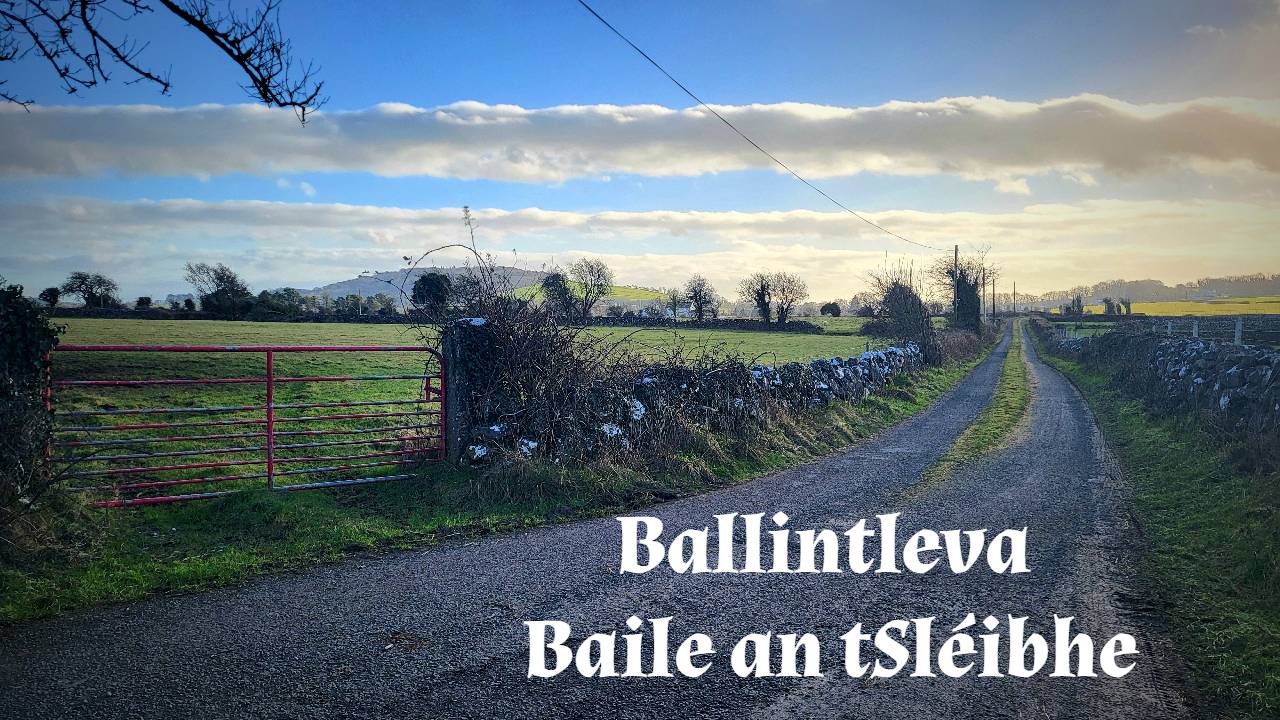
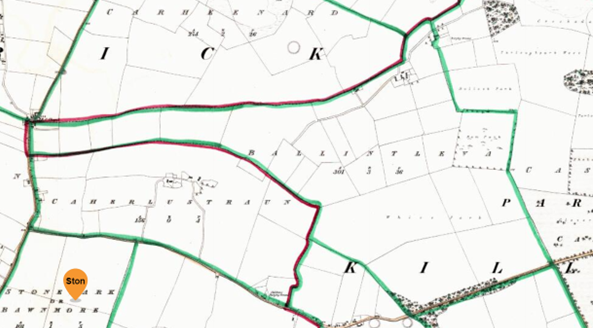
The name Ballintleva comes from the Irish Baile an tSléibhe, meaning townland of the moorland. It is situated in the civil parish of Killower, Barony of Clare. It is located in the east of the parish and is bounded on the east by Caltragh and Castlehacket, on the west by Beagh Beg, Caherlustraun/Caherlistrane, Carheenard and Raheen on the south by Cave and on the north by Caherakeeny. (Source Galway Library).
Irish name: Baile an tSléibhe
English name: Ballintleva
Meaning: The townland of the moorland or the townland of the mountain
Area: 301 Acres, 3 roods, 36 perches
Field names:
Civil Parish: Killower
Barony: Clare
O’Donovan’s Field Name Books
As part of the Ordnance Survey of Ireland, from 1830 to 1842, John O’Donovan helped to collect and record the Irish form of townland names throughout the country. Information for each townland was collected and written into the Name Book along with information relating to land quality, crops and housing. (Source: Timeline Genealogy)
Other names: Baile an tsléibhe, Ballintleva, Ballantleva (By. Surveyors Sketch Map), Ballyintleva (County Cess Collector), Ballinaleva (County Map), Ballintleva (Local), Ballntlevagh (Meresman), Ballaantleva (Proctor) and Ballinalevay (Rental).
Description: The property of a Major Kirwan of Castle Hacket. Rent 15 shillings per acre. Soil middling good. Farms from 4 to 31 acres. Religion all Roman Catholics. Antiquities. Crops very poor here, wheat, barley, potatoes and a little oats. No leases. Co. Cess 14D [Unable to read.] per acre half yearly.
Situation: This townland lies to the West of the parish of Belclare. Bounded on the North and West by the parish of Downapatrick. South by the parish of Downapatrick and townlands, Cave and Caltra, and on the East by townaldn, Castlehackett. In the Barony of Clare and County of Galway.
Other placenames in this townland:
Ram Park Situated in the East part of the townland of Ballintleva.
White Park Situated in the central part of the townland of Ballintleva.
The Down Survey
The first national-scale survey of its kind in the world, the Down Survey, taken in the years 1656 -1658, sought to acurately map the land in Ireland in order to facilitate its transfer from Irish Catholics to English Protestants after the Cromwellian conquest.
1641 (pre-Cromwell) states that the owner(s) of the townland of Ballintleva (Referred to as Kewbegg in the Down Survey of Ireland in the Parish of Killower in the county of Galway, Barony of Clare) was the Ulick Bourke of Castlehackett (Catholic). The Down Survey map of 1670 (post-Cromwell) shows that the owner(s) was Sir Edward Ormesby (Protestant). (Source: Trinity College Dublin)
49 plantation acres was deemed profitable land
49 plantation acres was fortified land
Tithe Applotment Book 1826
The Tithe Applotment Books were compiled between 1823 and 1837 in order to determine the amount which occupiers of agricultural holdings over one acre should pay in tithes to the Church of Ireland. The land was measured in Irish acres, or plantation acres at the time. This equated to 1.698 English acres.
There were no records found for Ballintleva.
1851 Old Age Pension Census Search Forms
There were no records found for Ballintleva.
Valuation Office Books 1824-1856: House & Field Books
The valuation of Ireland was a cadastral survey made for the purpose of levying tax on property. A valuation price was put on every piece of property in the country and this became the basis on which local tax was charged, at a rate per pound of valuation. (Source: National Archives)
The 1845 Field Books show the following as occupier in Ballintleva as Martin Burke, Patk Burke and Patrick Corcoran (10 January 1845). (Source: National Archives)
Martin Burke occupied a house with a barn, stables and a cow house. The initial valuation given by the valuator Edmund Forrest was £5 and 6 shillings which was increased by another valuator, David Williamson, to £5 and 10 shillings. However, it should be noted that both these amounts could be slightly larger. Due to tight binding of the original document, it cannot be determined if there were any extra amount in pennies. In addition, one of the valuators notes that Martin Burke’s “keeps a publick (sic) house” and that the dwelling is located “near the chapel”.
Patk Burke occupied a house with stables and a cow house which had an initial valuation of £3 and 18 shillings and 1 penny, this was reduced to £3.
Patrick Corcoran occupied a house with a barn, stables and a cart house which was given an initial valuation of £3 and 10 shillings and 10 pence by Edmund Forrest, this was reduced to £3 and 1 shilling and 10 pence by the valuator David Williamson.
The 1853 House Books show the following as house occupier in Ballintleva as Martin Burke, Henry Burke, Patrick Burke and Patrick Corcoran (August 1853). (Source: National Archives)
Martin Burke occupied a house and office with a valuation of £5 and 6 shillings and 11 pence. Henry Burke occupied a house and office with a valuation of £1 and 18 shillings. Patrick Burke occupied a house and office with a valuation of £3. Patrick Corcoran occupied a house and office with a valuation of £3 and 10 shillings and 10 pence.
1855 Griffith’s Valuation
Between 1847 and 1864, Richard Griffith was responsible for carrying out the Primary Valuation of Tenements (generally referred to as Griffith’s Valuation because of his role in the project). The aim of the valuation was to produce a uniform guide to the relative value of land throughout the whole of Ireland in order to decide liability to pay the Poor rate (for support of the poor and destitute within each Poor Law Union). The project required Griffith and a team of valuers to determine the value of every piece of land and property in the country enabling every occupiers’ tax due to be assessed. The information they collated covering all 32 counties was compiled into over 300 volumes and published over a period of 17 years. (Source: Find My Past)
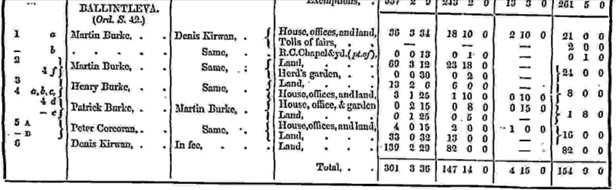
Griffith’s Valuation records the following occupiers in Ballintleva as Henry Burke, Martin Burke, Patrick Burke, Peter Corcoran and Denis Kirwan. (Source: Ask About Ireland)
Martin Burke occupied a house with offices and land totalling 36 acres, 3 roods and 34 perches which had a valuation of £18 and 10 shillings, the buildings had a valuation of £2 and 10 shillings. In addition, Martin Burke was allocated a valuation of £2 for Tolls of Fairs. The immediate lessor was Denis Kirwan. Martin Burke also occupied land totalling 69 acres, 3 roods and 12 perches which had a valuation of £23 and 18 shillings. In addition, Martin Burke occupied a Herd’s Garden totalling 30perches with a valuation of 2 shillings. The immediate lessor was Denis Kirwan.
Henry Burke occupied a house with offices and land totalling 3 acres, 1 rood and 25 perches which had a valuation of £1 and 10 shillings, the buildings had a valuation of 10 shillings. In addition, Henry Burke occupied land totalling 13 acres, 2 roods and 6 perches which had a valuation of £6. The immediate lessor was Denis Kirwan. Patrick Burke occupied a house with offices and garden totalling 2 roods and 15 perches which had a valuation of 8 shillings, the buildings had a valuation of 15 shillings. In addition, Patrick Burke occupied land totalling 1 rood and 25 perches which had a valuation of 5 shillings. The immediate lessor was Martin Burke. Peter Corcoran occupied a house with offices and land totalling 4 acres and 15 perches which had a valuation of £2, the buildings had a valuation of £1. In addition, Peter Corcoran occupied land totalling 33 acres and 32 perches which had a valuation of £13. The immediate lessor was Martin Burke.
Denis Kirwan held lands In Fee* totalling 139 acres, 2 roods and 29 perches which had a valuation of £82.
* Lands held ‘in fee’ were freehold tenures, derived from a grant from the Crown.
* ‘Immediate lessor’ means the person from whom the occupier named in the adjoining column was leasing the property
There was a Roman Catholic Chapel recorded in the Griffith’s Valuation of Ballintleva. The area of the Chapel and yard was 13 perches. The valuation was 1 shilling; however, the Roman Catholic Chapel and yard was exempt. The immediate lessor was Denis Kirwan.
**The current site of the chapel is actually located in the townland of Carheenard on the boundary with Ballintleva.
Population Statistics
The following statistics are from the census return records from 1842 to 1891 and the National Archives census returns for 1901 and 1911. (Source: Histpop)
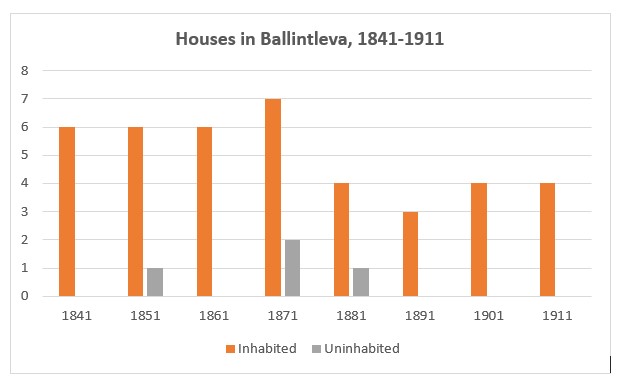
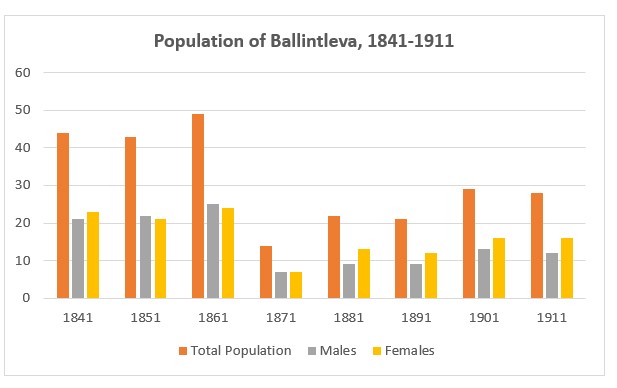
1841: 6 houses, 44 people (21 males and 23 females)
1851: 6 houses (incl. 1 unoccupied), 43 people (22 males and 21 females)
1861: 6 houses, 49 people (25 males and 24 females)
1871: 7 houses (incl. 2 unoccupied & 2 buildings), 14 people (7 males and 7 females)
1881: 4 houses (incl. 1 unoccupied), 22 people (9 males and 13 females)
1891: 3 houses, 21 people (9 males and 12 females)
1901: 4 houses, 29 people (13 males and 16 females)
1911: 4 houses, 28 people (12 males and 16 females)
1901 Census
The 1901 Census of Ireland records the following 29 individuals living in 4 households in Ballintleva. (Source: National Archives)
1. Daniel Corcoran (50) lived with his wife Bridget (27), sons Peter (7), Thomas (6) and Daniel Jr. (4), daughter Molly (1) and uncle Mark (30). * All householders were born in Co Galway and all were Roman Catholic. Daniel Sr’s and Mark’s occupation was listed as a Farmer, Bridget’s occupation was listed as a General Worker, Molly’s occupation was listed as a Farmer’s Daughter, Peter, Thomas and Daniel Jr. were listed as scholars. All householders could read and write with the exception of Molly. All householders could speak Irish and English with the exception of Molly who spoke Irish only.
2. John Hession (55) lived with his wife Bridget Sr. (54), and daughters Maggie (26), Bridget Jr. (24) and Winnie (21). All householders were born in Co Galway and all were Roman Catholic. John’s occupation was listed as a Herd, Bridget Sr’s occupation was listed as a Herd’s Wife, Maggie, Bridget Jr. and Winnie’s occupations were listed as a Herd’s Daughter. All householders could read and write with the exception of John. All householders could speak Irish and English.
3. Honor Hession (44) lived with her sons Martin (15) and John (5), daughters Mary (14), Delia (9) and Kathleen (7). Also present on the night of the census was male visitor Michael Lally (25) and female visitor Katie Hughes (20). All householders were born in Co Galway and all were Roman Catholic. Honor’s occupation was listed as a Farmer, John’s occupation was listed as Farmer’s Son, Martin, Mary Delia and Kathleen were listed as scholars. Michael Lally’s occupation was listed as a Labourer, while Katie Hughes’ occupation was listed as a General Servant. All householders could read and write. Only Honor and Martin Hession, Michael Lally and Katie Hughes were listed as being able to speak Irish and English.
4. Sarah Hoade (50) a widow, lived with her daughters Mary (22), Delia (16), Ellie (14) and Sarah Jr. (12), and sons Thomas (20), Patrick (19), Joseph (18) and Michael (10). All householders were born in Co Galway and all were Roman Catholic. Sarah’s occupation was listed as a Farmer, Thomas, Patrick and Joseph were listed as Farmer’s Son, Mary, Delia, Ellie and Sarah Jr. were listed as a Farmer’s Daughter, Michael was listed as a scholar. All householders could read and write. Only Sarah Sr. could speak Irish and English.
There was one first class house and three second class houses. The first-class house had a roof of either slate, iron or tiles, the remaining three second class houses had either a roof of thatched, wood or other perishable material. All houses had walls constructed of either brick, stone or concrete. The first-class house had six windows, one second class house had three front windows, while the remaining two second class houses had four front windows.
There was no information on out-offices and farm steadings.
Note
* The enumerator has recorded Mark Corcoran (30) as the uncle of the head of the household Daniel Corcoran (50). This may be correct; however, the enumerator may have recorded him as the uncle of Daniel and Bridget’s sons and daughter rather than Daniel’s uncle, or his age is recorded incorrectly as in the 1911 census a cousin, rather than uncle called Mark Corcoran is present though his age is recorded as being 60. If this is the same person and the age is recorded correctly, he would have been 50 in 1901 and may have been Daniel Corcoran’s uncle.
1911 Census
There were 4 houses in Ballintleva with a total of 28 individuals recorded in the 1911 Census of Ireland. (Source: National Archives)
1. Sarah Hoade (68) a widow, lived with her sons Thomas (31), Joseph (29) and Michael (21), daughters Ellie (24) and Sarah Jr. (22), granddaughter Nora Larner (4) and grandson Dominick Greaney (2). All householders were born in Co Galway and all were Roman Catholic. Sarah Sr’s occupation was listed as a Farmer, Thomas, Joseph and Michael were listed as Farmer’s Son; Nora Larner was listed as a scholar. No occupation was listed for the remaining householders. All householders could read and write with the exception of Nora Larner and Dominick Greaney. All householders could speak Irish and English with the exception of Ellie and Sarah Hoade Jr., Nora Larner and Dominick Greaney.
2. Bridget Corcoran (38) a widow, lived with her sons Peter Joseph (17), Thomas Francis (16) and Daniel Vincent (13), daughters Winifred Mary (11), Bridget Christina (9) and Mary Teresa (7), and relative Mark Corcoran (60). All householders were born in Co Galway and all were Roman Catholic. Bridget’s occupation was not listed, Peter Joseph and Thomas Francis’ occupations were listed as Farmer’s Son. Daniel Vincent, Winifred Mary, Bridget Christina and Mary Teresa were listed as scholars. No occupation was listed for Mark. All householders could read and write. All householders could speak Irish and English with the exception of Winifred Mary, Bridget Christina and Mary Teresa who spoke English only.
3. Honor Hession (56) a widow, lived with her sons Martin (25) and John (15), daughters Mary (23), Delia (19) and Kathleen (17), cousin Michael Lally and niece May Newell (11). All householders were born in Co Galway and all were Roman Catholic. Honor’s occupation was not listed as a Farmer, martin Hession and Michael Lally’s occupation was listed as Shepherds. John Hession and May Newell were listed as scholars. No occupation was listed for the remaining householders. All householders could read and write. All householders could speak Irish and English.
4. John Hession (74) lived with his wife of 40 years Bridget Sr. (73), and daughters Bridget Jr. (28) and Winifred (26). All householders were born in Co Galway and all were Roman Catholic. John’s occupation was listed as a Shepherd. No occupation was listed for the remaining householders. Only Bridget Jr. and Winifred could read and write. All householders could speak Irish and English.
All four dwellings were second class houses. Two of the houses had a roof of either slate, iron or tiles, the remaining two second class houses had either a roof of thatched, wood or other perishable material. All houses had walls constructed of either brick, stone or concrete. One second class house had five front windows, one had four, while the remaining two second class houses had three front windows. There were 3 stables, 5 cow houses, 3 calf houses, I dairy, 4 piggeries, 4 fowl houses, 3 barns, 1 potato house and 1 shed.
No Comments
Add a comment about this page